Businesses occasionally ask us for armed guards. The answer is almost always that they do not need them, and in British Columbia they probably cannot have them anyway.
That surprises people, so it is worth explaining properly.
Most BC security is unarmed by design
Walk into any office tower, shopping centre, hotel, warehouse or hospital in this province and the security officer you see is unarmed.
That is not a cost decision. It reflects how security is regulated here and, more practically, what the job actually is.
The work is observing, deterring by presence, controlling access, de-escalating and documenting. A firearm contributes nothing to any of those and introduces risk to all of them.
What BC regulates
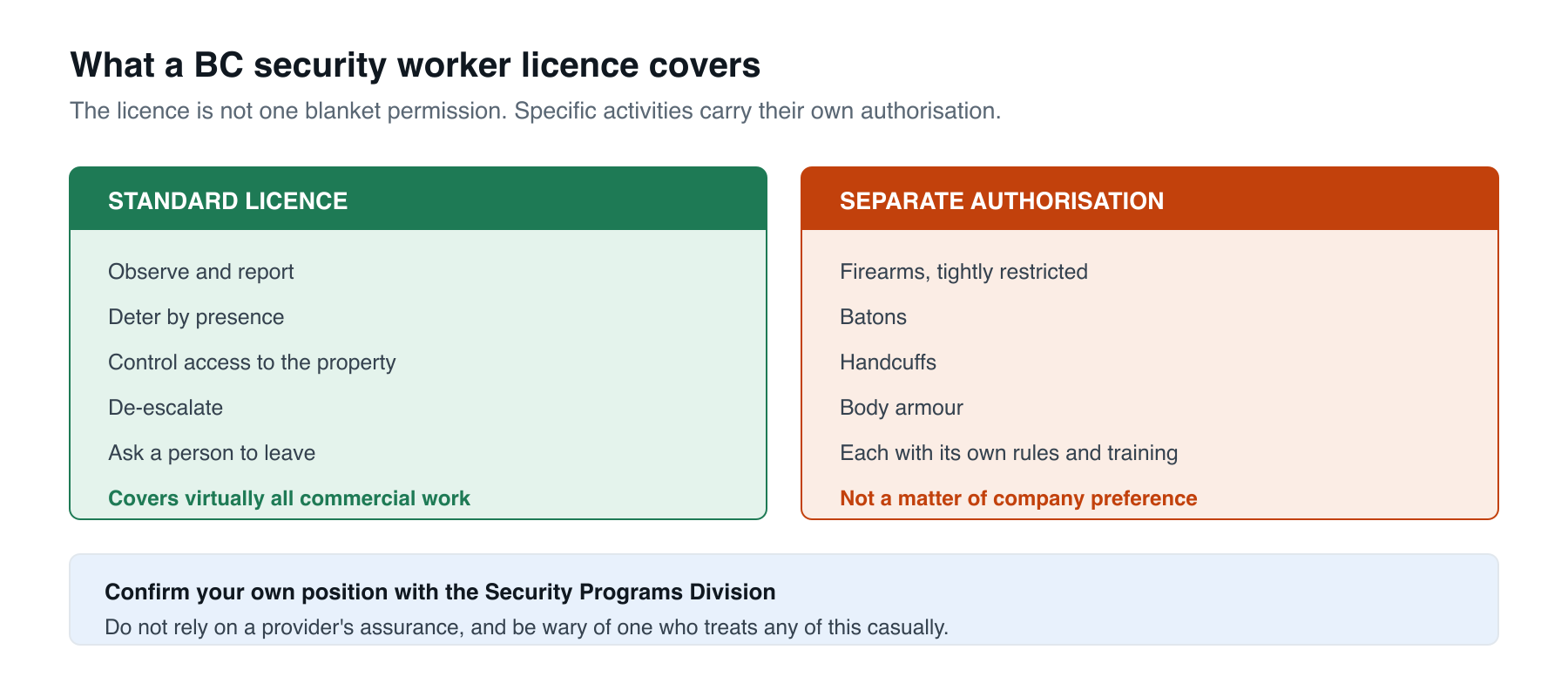
Security work in BC is licensed under the Security Services Act, and the licence is not a single blanket permission. Specific activities carry their own authorisations.
Carrying a firearm in the course of security work is tightly restricted and requires separate authorisation beyond a standard security worker licence. In practice it is confined to narrow categories, most visibly armoured car and cash-in-transit work, which is a specialised sector with its own requirements.
Other equipment is regulated too rather than being a matter of company preference. Batons, handcuffs and body armour each have their own rules around authorisation and training.
If you want the authoritative position for your situation, the Security Programs Division is the source. Do not rely on a provider's assurance, and be wary of one who treats any of this casually. Our Security Services Act guide covers the wider framework.
Why unarmed works
The thing a guard actually prevents is almost never stopped by a weapon.
Most incidents on a commercial site are someone trying a door, someone sleeping in a loading bay, a dispute escalating in a lobby, a theft in progress, or a medical emergency. Every one of those is better handled by presence, a calm conversation and a phone call than by anything else.
Deterrence does most of the work and it comes from visibility, not armament. Someone deciding whether to try your fence line is weighing whether anyone is watching.
And de-escalation is the actual skill. An officer who can talk a situation down resolves it without an incident report, an injury or a claim. That is what good providers hire and train for. Our guard duties article sets out the legal scope, which matters here: guards are not police and do not have police powers.
The liability argument
For a business owner, this is usually the decisive part.
Introducing a weapon into an incident on your premises raises the ceiling on how badly it can end. For you, not just for the officer.
Set against that, consider what is actually being protected. Stock, equipment, a building. All insured, all replaceable. The merchandise is never worth the exposure, which is the same reason well-run providers train officers to avoid physical intervention and pursuit entirely. Our organized retail crime guide covers where that line sits in practice.
When the answer is something else
Sometimes a request for armed guards is really a request for something a weapon would not provide.
A specific, credible threat to a person. That is close protection, and it starts with a risk assessment rather than a headcount. Done properly it is discreet and heavily weighted toward advance planning.
Cash or high-value goods in transit. That is a specialised armoured transport sector, not general guarding, and you want a provider who does only that.
A site that feels genuinely unsafe. Usually the honest answer is lighting, access control, patrol frequency and a better-trained officer rather than a different kind of officer. A site assessment tends to find that.
Previous incidents that went badly. Worth looking at what actually failed. Often it was documentation, response time or a propped door rather than a lack of force.
What to ask a provider instead
Better questions than "do you offer armed guards":
What is your written policy on physical intervention and pursuit?
How do you train de-escalation, and how often?
Who supervises this site and how often do they attend in person?
What does your incident reporting look like, and how fast do I get it?
Can I see your business licence and liability certificate? Ours is $2M CAD in comprehensive general liability.
A provider who markets aggressive intervention as a selling point is offering you risk rather than protection. Our guide to choosing a security company in BC covers the rest of the vetting.
Talk to us
Fireball Security supplies licensed, unarmed security officers across British Columbia, trained to de-escalate and to document. Operating since 2020, 100+ guards, 100+ clients in 11 cities.
If you are weighing this for your own site, tell us what has happened and we will tell you what actually fits. Get in touch or call 250-899-6620.