"We need an alarm" covers two completely different purchases, and businesses regularly buy one while meaning the other.
One is a system that detects and reports. The other is a person who turns up. They are sold by different companies, and you can have either without the other.
Here is the difference, and which one your situation actually calls for.
The three parts
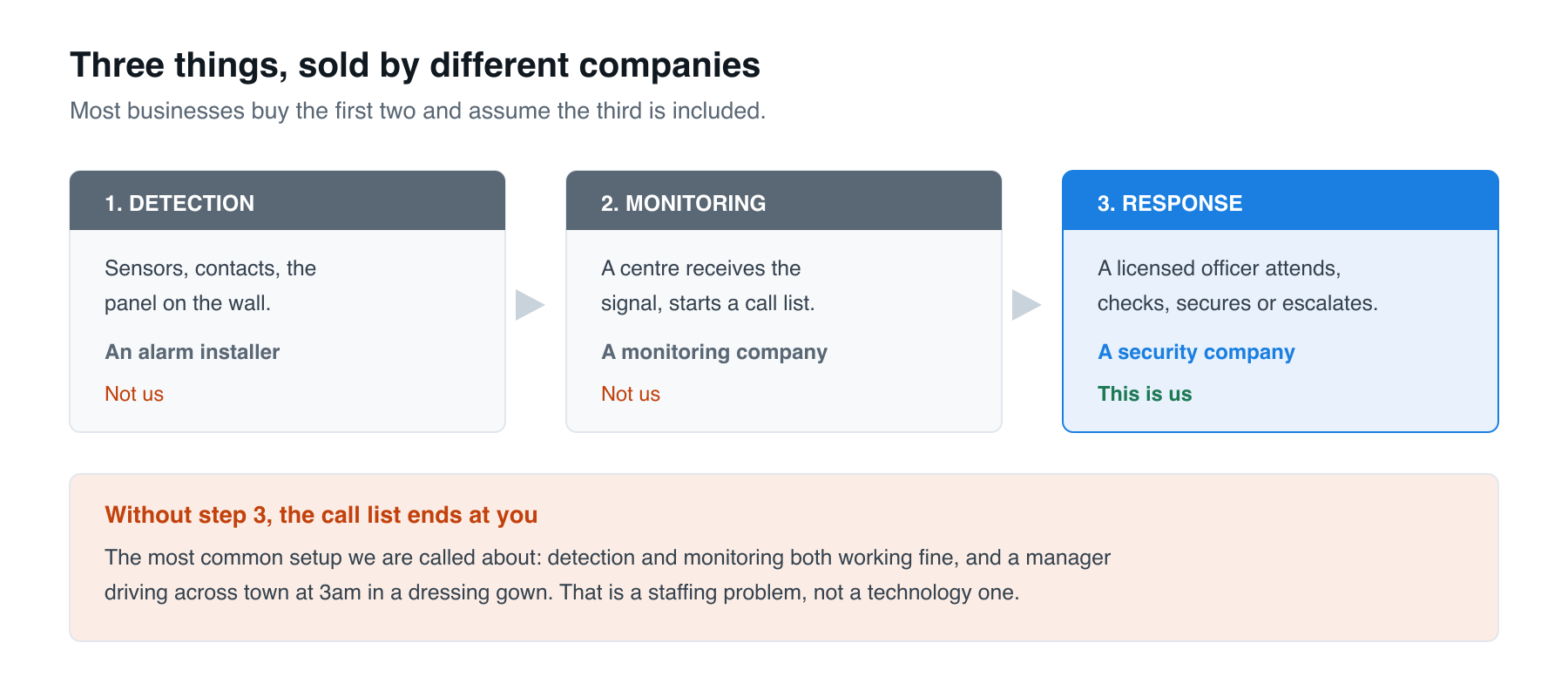
Detection is the hardware. Sensors, contacts, motion detectors, the panel on the wall. It notices something and triggers.
Monitoring is the service that watches the signal. When the system triggers, a monitoring centre receives it and starts a call list. This is a subscription, usually to the company that installed the system.
Response is a person attending the building. A licensed officer drives there, checks it, and either secures it or calls police.
Most businesses buy the first two and assume the third is included. It is not. Without a response arrangement, the call list ends at you.
What we do and do not supply
To save you a phone call.
We supply response. Licensed officers who attend your premises when an alarm goes off, check the perimeter, assess, and either secure the building or escalate to police.
We do not sell, install or monitor alarm systems or cameras. That is a different trade, and if you need detection or monitoring, an alarm systems installer is the right supplier.
Which one you are missing
Run through this honestly.
No system at all. Start with an installer. Response without detection has nothing to respond to.
A system nobody monitors. Very common in small commercial units. The siren sounds, the neighbours ignore it, and nobody is told. You need monitoring before you need response.
Monitored, and the call list is your manager's mobile. This is the most common situation we are called about. The detection and monitoring work fine. The response is a person in a dressing gown driving across town at 3am.
That last one is where alarm response earns its cost, and it is a staffing problem rather than a technology one.
The honest version on false alarms
Before buying response, look at your activation history.
Most alarm activations are faults. A door that does not close properly, staff entering the wrong code, a failing sensor, a draught moving something in a warehouse.
Every one of those costs an attendance fee once you have response in place, and in many BC municipalities repeated police callouts attract bylaw charges.
So the cheapest thing you can do is fix the false alarm rate first. Which door, which code, which sensor. A monitoring company can usually tell you from the activation log.
We would rather attend four real calls a year than forty faults, and any provider who does not raise this before selling you a contract is not being straight with you.
When response is genuinely worth it
It earns its cost when:
Your premises are a long way from whoever currently holds keys.
Staff are being called out at night, which is both a safety issue and a reason people leave.
Your insurer has asked for it, or will adjust premiums with it in place.
You need documented attendance. The log showing an officer attended, when, and what they found is evidence in a way a monitoring record is not.
Your activations are real rather than faults.
When it is not
If your alarm triggers twice a year and your manager lives ten minutes away, you may not need a contract.
If the activations are nearly all faults, fix the system.
And if the underlying problem is that people are trying your doors regularly, response is reactive. Mobile patrol prevents, and for most sites it costs less than repeated callouts.
What to ask a response provider
Where is the officer who would attend my site based overnight? Not where the office is.
How many sites are they covering on that shift?
What is a realistic attendance window for my address at 3am?
What happens if two alarms go off at once? The honest answer is that one gets attended first, and a provider who says that is telling you the truth.
Do you hold keys, and what does that change? Without keys the officer can only assess from outside, which limits what you are buying.
Keep the two suppliers talking
One practical thing worth doing.
Your monitoring company and your response provider need each other's details, and your call list needs to be current. The most common failure in this chain is not technology. It is a contact list that has not been updated since somebody left the business.
Review it quarterly. It takes ten minutes.
Talk to us
If you have a monitored system and no plan for who attends, that is the gap worth closing. If you have no system at all, we will tell you to call an installer first.
Fireball Security provides alarm response across British Columbia, usually alongside mobile patrol on the same route, which keeps both the attendance time and the cost down. Operating since 2020, 100+ licensed guards, 100+ clients in 11 cities.
Tell us about your site or call 250-899-6620.