
Two quotes land on your desk. One is from a staffing agency offering security personnel at $26 an hour. The other is from a security company at $32.
Same number of guards, same hours. Six dollars an hour apart.
They are not the same purchase, and under BC law the difference matters more than the price gap suggests.
What the Security Services Act actually requires
In British Columbia, two things must be licensed.
The individual doing security work needs a security worker licence.
And the business supplying security services to another business needs a security business licence.
That second one is where the distinction sits. A company that supplies security services to clients must hold a business licence for it. A general staffing agency placing workers into other roles does not automatically hold one.
So the first question for any quote is simple: what is your security business licence number? It is verifiable, and a supplier who hesitates has answered it.
What the cheaper rate leaves out
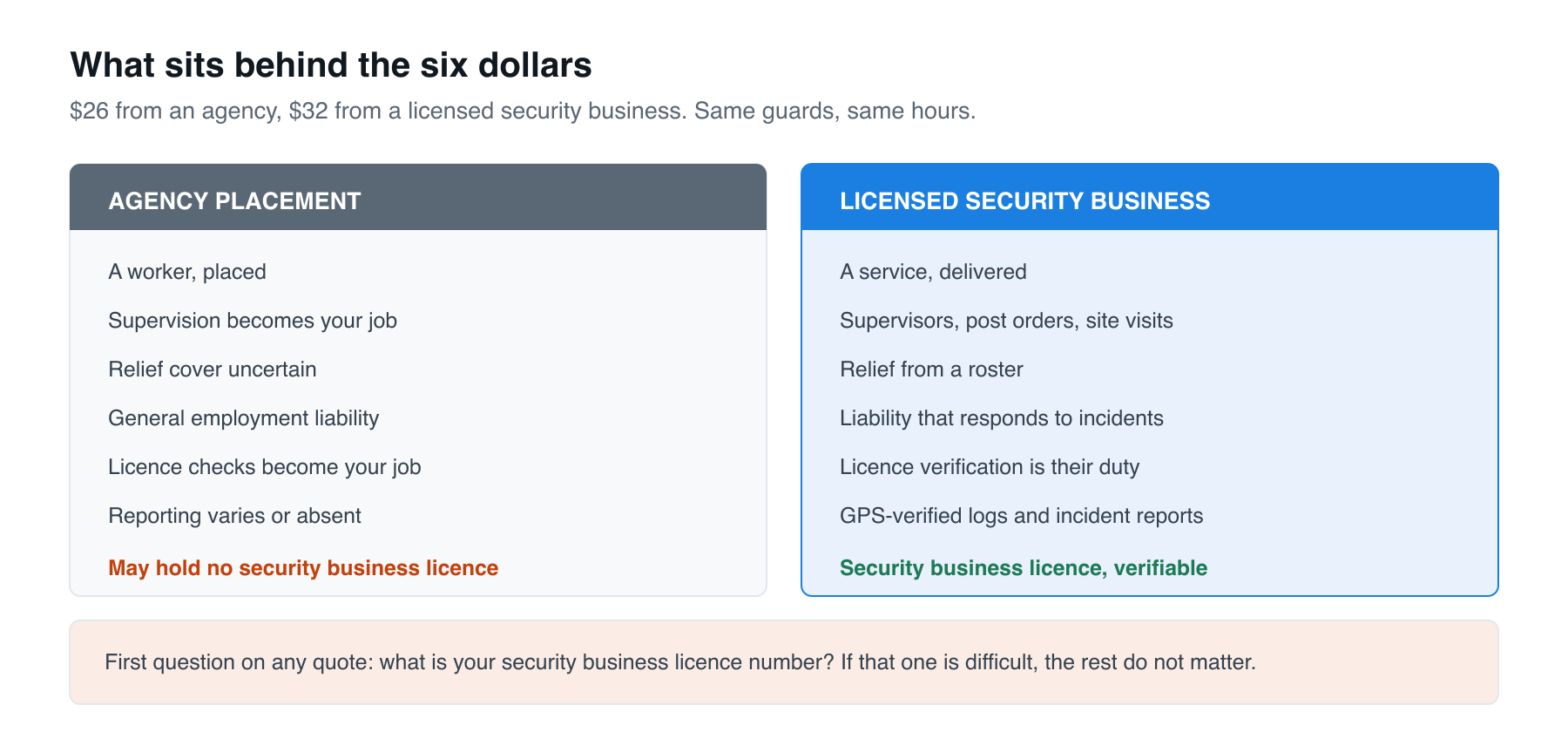
The six dollars is not margin. It is services.
Supervision. A security company employs supervisors who write post orders, attend sites, review reports and manage performance. An agency places a worker and invoices you. Supervision becomes your job.
Relief coverage. When the officer is sick, a security company has a roster. An agency may or may not be able to fill it, and often not at short notice.
Liability insurance appropriate to security work. General employment liability is not the same as coverage that responds to a security incident on your premises. Ask what the policy actually covers and for the certificate. Ours is $2M CAD in comprehensive general liability.
Training and briefing for the post. Not generic onboarding, but this building, these doors, this escalation path.
Reporting. Incident reports and GPS-verified attendance logs that stand up to an insurer. Our guide on what reporting to expect covers the detail.
Licence verification. Someone has to confirm every officer on your site holds a current worker licence. With a security company that is their obligation. Otherwise it is yours.
Count those and the gap closes, then reverses.
Where the risk actually lands
This is the part worth thinking through before signing.
If an incident happens on your property and the supplier was not licensed to provide security services, you are the business that engaged them. Your insurer will ask. So will anyone bringing a claim.
If the officer's worker licence had lapsed and nobody checked, the same question applies.
And if supervision was nominally yours because you engaged a placement rather than a service, then the decisions that officer made on your site were made under your direction.
None of that is theoretical. It is the practical reason the licensing regime distinguishes between the two.
When an agency is genuinely fine
Being fair about it, because there are cases.
If you are hiring a security guard as your own direct employee, and an agency is simply helping you recruit, that is a recruitment service and it is perfectly normal. You then carry supervision, licensing verification, WorkSafeBC and insurance yourself, knowingly. Our in-house versus contract comparison works through what that actually costs.
The problem is the middle case: an agency supplying ongoing security coverage as a service, priced like a contract but without the business licence or the infrastructure behind it. That is the arrangement to avoid.
Five questions that settle it
1. What is your security business licence number?
2. Are the officers your employees, or placements?
3. Who supervises them on my site, and how often do they attend?
4. What happens when the scheduled officer cannot come in?
5. Can I see your liability insurance certificate?
Any licensed security company answers all five in a couple of minutes. If a supplier struggles with question one, the rest do not matter.
A note on rates
A quote well below the market is a signal rather than a saving.
Guards must be licensed. A licensed company must carry insurance, pay WorkSafeBC and pay enough to keep people worth having. Those costs are fixed, so a materially lower rate means something has been removed: supervision, insurance depth, or the officer's own pay, which shows up later as constant turnover on your site.
Our price list sets out what the work actually costs in BC and what sits behind each number.
Talk to us
If you have a quote in front of you and are not sure which kind of supplier it came from, the licence number answers it in one search.
Fireball Security is a licensed security business operating across British Columbia since 2020, with 100+ licensed guards serving 100+ clients in 11 cities and $2M CAD in comprehensive general liability. We are happy to provide our licence and certificate before you ask.
Send us your scope or call 250-899-6620.