

Executive protection has an image problem. The word conjures earpieces and dark suits walking through a lobby, which is close to the opposite of how the work is actually done.
For a BC company arranging cover for a visiting executive, a board meeting or a contentious announcement, most of the value sits in planning that happens before anyone arrives. This guide covers what the service consists of, when a business genuinely needs it, and what to ask for.
What it actually consists of
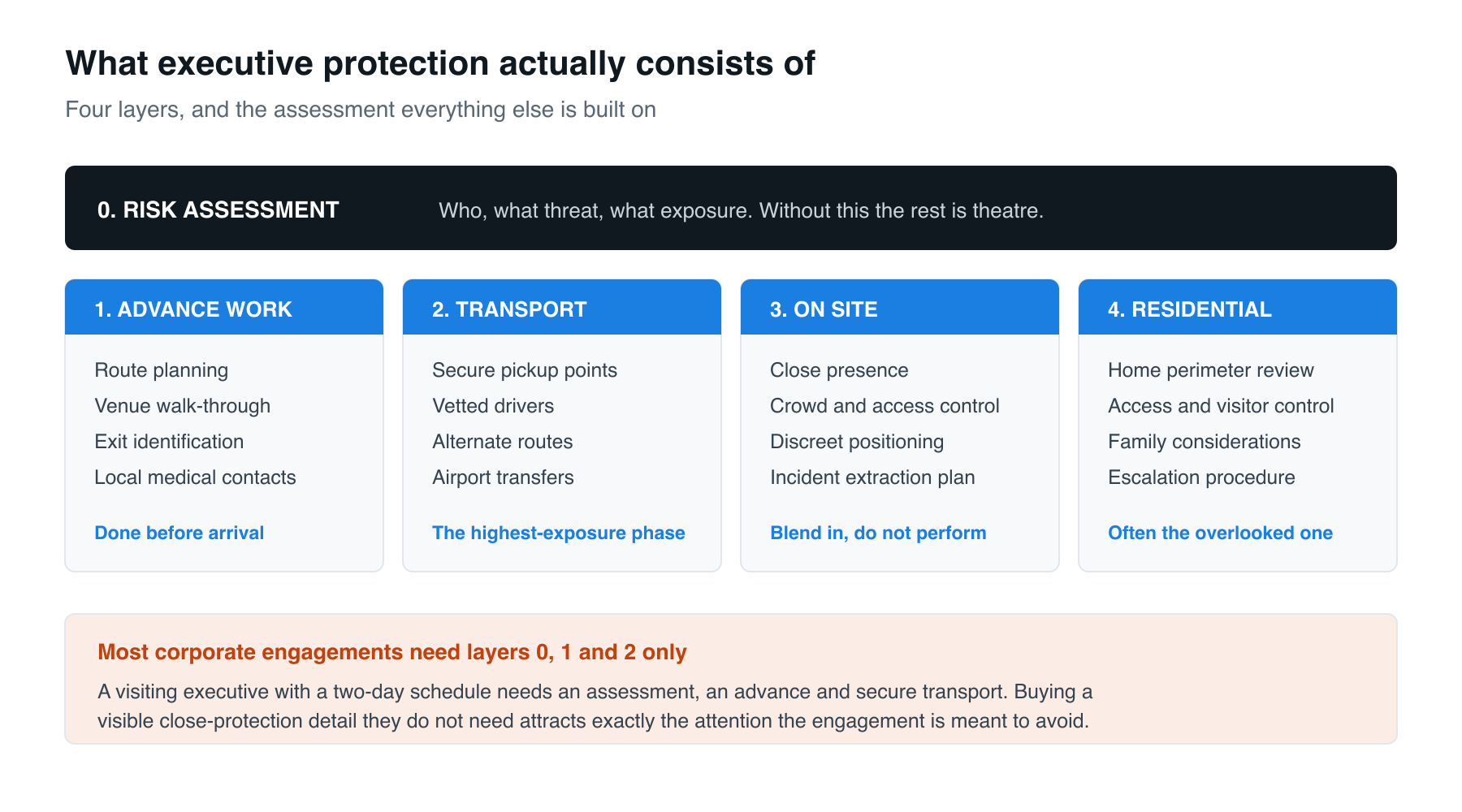
The assessment is not a formality that precedes the real work. It is the thing that determines whether the other layers are needed at all, and buying protection without one means guessing at your own threat profile.
The risk assessment
Before anyone is assigned, a competent provider establishes:
- Who the principal is and what makes them a potential target. Public profile, role, recent decisions, media exposure.
- Whether a specific threat exists, or whether this is general precaution. These lead to very different arrangements.
- The itinerary. Where they will be, when, and how predictable that is. Predictability is the main vulnerability in most corporate travel.
- The environments. A downtown hotel, a industrial site visit and a public AGM carry different problems.
- Digital exposure. Whether the schedule is discoverable in advance, which is frequently how a problem starts.
A provider who quotes a number of guards before asking these questions is selling headcount rather than protection.
Layer one: advance work
The least visible part of the service and usually the most valuable.
Someone visits the locations beforehand. They establish where a vehicle can pull in, which entrance avoids the public frontage, where the exits are, which floor the room is on, and where the nearest emergency department is. They identify the points where the principal is exposed and stationary, because those are where incidents happen.
For most corporate engagements this layer plus transport is the entire requirement.
Layer two: secure transport
Movement is the highest-exposure phase of almost any engagement, and it is where most corporate arrangements are weakest.
What good looks like: vetted drivers, pickup points that are not the public front door, planned primary and alternate routes, and airport transfers arranged rather than improvised on arrival.
What is common instead: a rideshare booked by an assistant, arriving at the main entrance, at a time published in a conference programme.
Layer three: on-site presence
Where a physical presence is warranted, the objective is to be unremarkable.
A protection officer at a corporate event should read as staff. They position themselves with sightlines to the principal and the entrances, they know the extraction route, and they do not stand behind the principal looking like security. Visible protection announces that someone is worth protecting, which is the opposite of what most corporate clients want.
This is also why executive protection is a different hire from event security. Event guards manage a crowd. A protection officer manages proximity to one person.
Layer four: residential
The layer companies most often skip, because it feels like it belongs to the individual rather than the business.
If an executive has received threats connected to their role, the exposure does not end when they get home. A perimeter review, sensible access and visitor procedures, family considerations and a documented escalation path cost very little compared with the rest and close the most obvious gap.
When a BC company actually needs this
Honest answer: less often than providers imply, and more often than most companies think.
Clear cases:
- A specific, credible threat connected to the principal's role
- A contentious announcement, restructuring or labour dispute
- A public-facing individual with a genuine profile
- Travel into an unfamiliar or higher-risk environment
- A high-value transaction where the principal's movements are known in advance
Usually not required:
- Routine domestic travel with no threat indicators
- A conference where the principal is one speaker among many
- General nervousness with no assessment behind it
If nobody has done an assessment, the honest first step is an assessment, not a detail.
What to ask a provider
1. What does your risk assessment cover, and who performs it?
If the answer is vague, or the assessment is skipped in favour of a quote, stop there.
2. Are your protection officers licensed under the Security Services Act?
Executive protection is licensed security work in BC. Ask for the individual licences and the company's business licence.
3. What is your advance-work process?
You want a specific description of who visits what and when, not an assurance that it is handled.
4. How do you handle transport?
Vetted drivers, planned routes, alternates. If transport is subcontracted, ask who to and whether they are vetted.
5. What is your policy on visibility?
The right answer is that it depends on the assessment and defaults to discretion.
6. What insurance do you carry?
Ask for the certificate. Fireball Security carries $2M CAD in comprehensive general liability.
7. Will any part of this be subcontracted?
Get it in writing.
Our guide to choosing a security company in BC covers the general vetting, and bodyguard and executive protection in Vancouver covers the consumer-facing side.
What it costs
Executive protection sits above every other service in our cost guide, and for good reason: the officers are more experienced, the advance work is real labour, and the engagements are short and intensive.
The cost driver most companies do not anticipate is hours, not headcount. A single officer covering a two-day visit including travel days costs more than a larger presence at a four-hour event. Ask providers to quote the itinerary rather than a number of people.
Advance work is billable and should be. A quote that omits it is quoting a lesser service.
Frequently asked questions
1. What is executive protection?
Close protection for a named individual, built on a risk assessment, typically combining advance work, secure transport, on-site presence and sometimes residential measures.
2. Is executive protection the same as hiring a bodyguard?
The terms overlap, but executive protection describes a planned service with an assessment and advance work behind it, rather than an individual assigned to stand nearby.
3. Do executive protection officers need a licence in BC?
Yes. It is licensed security work under the Security Services Act, requiring both individual worker licences and a licensed security business.
4. How much does executive protection cost?
More per hour than any other guarding service, and the driver is the length of the engagement rather than the number of officers. Ask for a quote against the itinerary.
5. Does my company need this for routine travel?
Usually not. Without threat indicators, routine domestic travel rarely warrants it. Start with an assessment rather than a detail.
6. Can protection be discreet?
It should be, in most corporate contexts. Visible protection signals that someone is worth targeting, which is rarely what a company wants.
7. What is advance work?
Visiting locations before the principal arrives to establish access, exits, exposure points, parking and medical facilities. It is the least visible and often most valuable part of the service.
Arranging cover
If you have an engagement coming up and are unsure whether it warrants protection, that question is itself the assessment, and it is worth twenty minutes rather than a guess.
Fireball Security has operated across British Columbia since 2020, serving 100+ clients in 11 cities with a roster of 100+ licensed guards. See our executive protection service, get in touch, or call 250-899-6620.