Access control gets sold as a hardware problem. Buy the readers, issue the fobs, and only the right people get in.
Then somebody props the loading door open because they are carrying boxes, and the system has been defeated by a doorstop.
Hardware and people solve different halves of this. Here is which half you actually have.
What hardware is genuinely good at
Give it credit where it earns it.
A card or fob system creates a record of who entered and when. That log is valuable, for investigations and for insurers.
It scales. Issuing and revoking access for 200 staff is trivial with a system and impossible with keys.
It removes the lost-key problem. A fob gets deactivated in seconds; a lost master key means a rekey.
And it works continuously without being paid overtime.
For a straightforward office with staff who all badge in, hardware alone covers most of the requirement.
Where it fails, every time
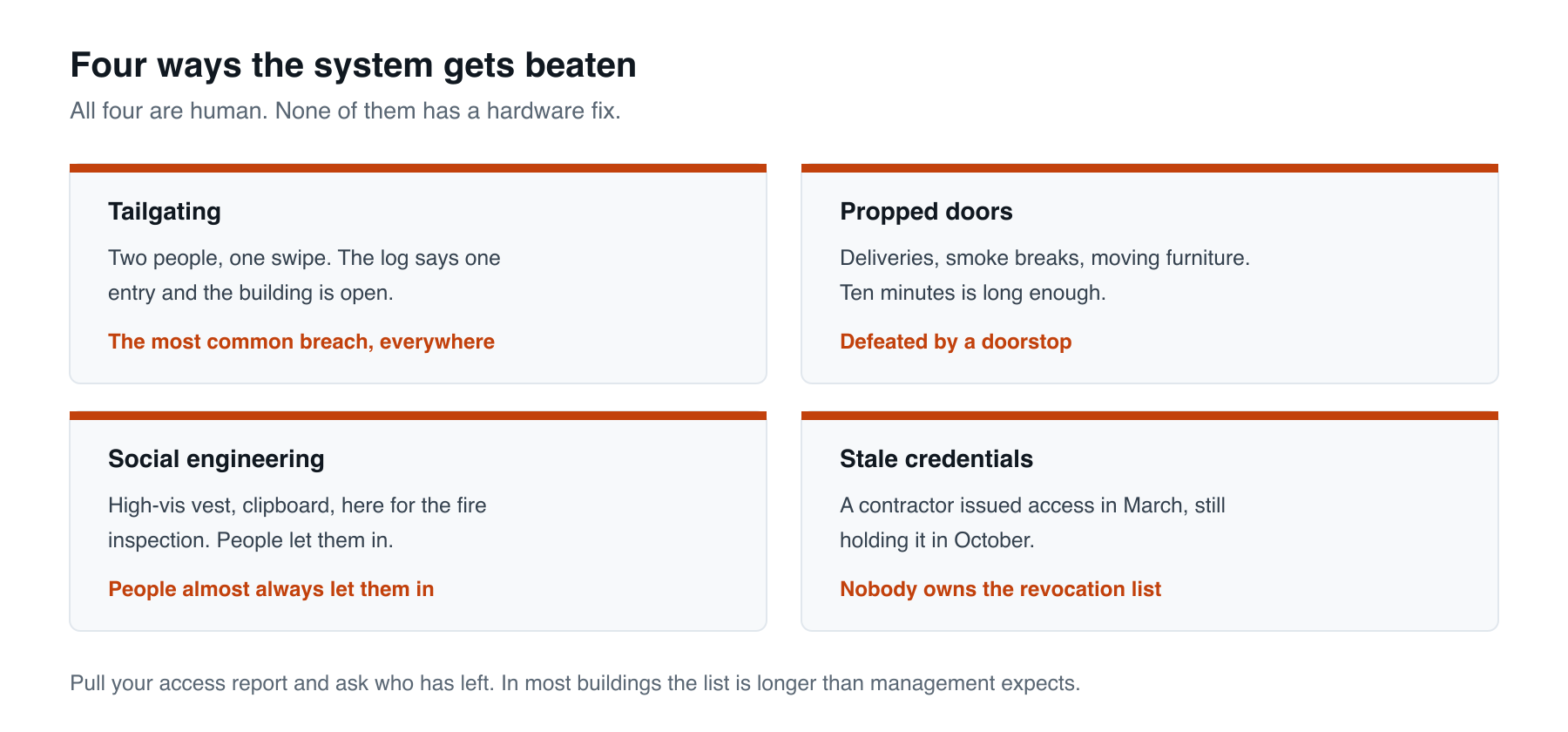
The failures are predictable and they are all human.
Tailgating. Someone walks in behind an authorised person. The system logs one entry and two people came through. No technology currently in common use at commercial buildings prevents this reliably.
Propped doors. Deliveries, smoke breaks, moving furniture. A door propped for ten minutes is an open building.
Social engineering. Someone in a high-vis vest with a clipboard, who says they are here for the fire inspection. People let them in. People almost always let them in.
Contractors. Issued access for a job that finished in March, still holding it in October. Nobody owns the revocation list.
Each of these is a person problem. You cannot buy a reader that fixes them.
What staff add
A person at the door does the things the system cannot.
They notice that two people came through on one swipe, and they say something.
They judge. A contractor turning up unannounced is either expected or is not, and a human can establish which in thirty seconds.
They close the propped door and find out who propped it.
They handle the visitor who does not have an appointment without it becoming a confrontation, which is a trained skill. Our concierge security comparison covers what that training involves.
And they produce an incident record that means something later.
Which you need
Start with what your building actually is.
Offices with badged staff and few visitors. Hardware does most of the work. Add a reception presence during business hours if visitor volume justifies it.
Buildings with public access or high visitor flow. Hardware plus a staffed point. The hardware controls the restricted areas; the person controls the front.
Residential and strata. The lobby door is the vulnerability, and tailgating is constant. Hardware alone will not hold it. Our Vancouver residential guide covers this.
Industrial sites and yards. Gate control, often with vehicle checks. Usually a staffed gate during operating hours plus patrol overnight.
Restricted areas inside a larger building. Data rooms, pharmacy, cash handling. Hardware with a proper audit trail, plus a revocation process somebody owns.
The cheapest improvement most buildings can make
Before buying anything, do these.
Walk the building at the time your incidents actually happen, not at noon. Look at which doors do not latch, which lights are out, and which routes bypass your controlled entrance entirely.
Then audit your access list. Pull the report of everyone holding valid credentials and ask who has left, whose contract ended, and who nobody recognises. In most buildings that list is longer than management expects.
Those two exercises cost nothing and routinely find more than a new system would fix. A site assessment covers both.
What we do and do not supply
To be plain, since "access control" means two different things depending who you ask.
We supply the people: officers staffing entrances and gates, checking credentials, managing visitors and contractors, and documenting it.
We do not sell, install or monitor card reader systems, door hardware or cameras. If that is what you need, a systems installer is the right supplier and we will say so.
Our access control and concierge guide covers how the two sides work together.
Talk to us
Fireball Security staffs access points for commercial, industrial and residential clients across British Columbia. Since 2020, 100+ licensed guards, 100+ clients in 11 cities, $2M CAD in comprehensive general liability.
See our access control service, request a quote, or call 250-899-6620.