

Before a business compares security companies, it usually has to settle a more basic question: do we hire and manage guards ourselves, or contract it out?
Most comparisons of the two are written by security companies, so they reach a predictable conclusion. This one sets out the actual cost structure of both, including the cases where hiring in-house genuinely wins.
The comparison most budgets get wrong
The mistake is comparing an in-house wage to a contract hourly rate. Those are not the same kind of number.
A contract rate is all-in. An in-house wage is one line out of eight.
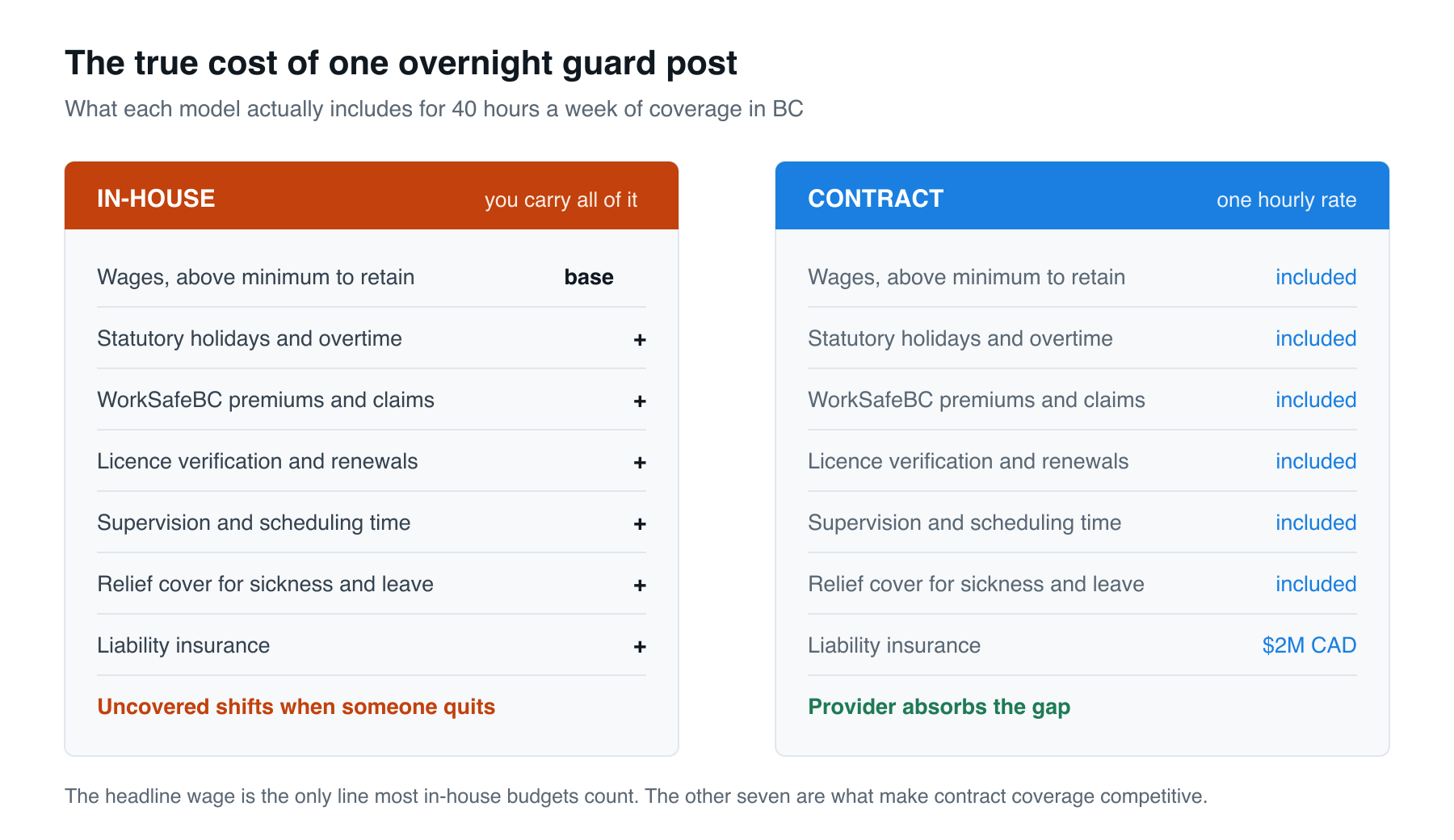
When a business quotes itself $22 an hour for an in-house guard and compares that to $32 from a provider, it is comparing a wage to a service. The other seven lines still exist. They have just moved onto your own overhead, your own risk register, and in most cases your own evenings.
What in-house actually costs
Work through it honestly for a single overnight post, 40 hours a week.
- Wages. BC guards must be licensed, and licensed guards have options. Paying at the bottom of the market produces constant turnover, and turnover on a security post is not a neutral cost. Every new guard is a stranger to your site for their first fortnight.
- Statutory holidays and overtime. Security does not stop for holidays. Coverage on those days costs premium rates, and a single-guard roster generates overtime whenever anything goes wrong.
- WorkSafeBC. Premiums, plus your exposure if a claim arises. Security work carries real incident risk.
- Licence administration. You are responsible for verifying that each guard holds a current worker licence and for tracking renewal dates. A lapsed licence means an unlawful shift.
- Supervision. Unsupervised guards drift. Somebody has to write post orders, review reports, attend the site and manage performance. That is management time, not guard time.
- Relief coverage. This is the one that breaks in-house arrangements. When your single guard is sick, on holiday, or resigns, the post is empty and you have no bench.
- Liability insurance. You need coverage appropriate to the work, and you need to know it responds to a security incident rather than excluding it.
- Recruitment. Advertising, screening, interviewing and onboarding, repeated at every departure.
Total those and the effective hourly cost of an in-house guard is routinely higher than the contract rate that looked expensive, before counting the shifts nobody covered.
What a contract rate includes
A rate from a licensed BC provider generally starts around $28 an hour and runs into the $40s depending on service, hours and notice. Our security guard cost guide breaks that down.
What the number buys:
- A licensed guard, with the provider carrying the verification burden
- Relief coverage from a roster, so absence is the provider's problem
- Supervision by someone whose job it is
- Insurance, which at Fireball Security means $2M CAD in comprehensive general liability
- Scalability, so a busy fortnight does not require a hiring round
- Reporting infrastructure, including GPS-verified patrol logs and incident reports with photographs
The genuine trade-off is control. A contracted guard works to your post orders but is employed by someone else.
When in-house genuinely wins
Three situations, and it is worth being straight about them since most articles on this topic pretend there are none.
You need genuinely continuous coverage at scale. Once you are staffing multiple posts around the clock, the economics shift. At that volume you are effectively running a security department, and the provider margin starts to outweigh the overhead you would absorb.
Security is a core part of the role. If the person is a building manager who also handles access, or a receptionist with security duties, that is an employee with a security function rather than a security post. Contracting it out fragments the job.
The work requires deep institutional knowledge. Some environments need someone who knows the building, the tenants and the history in a way that takes years. Low turnover matters more than flexibility there.
Outside those, the arithmetic usually favours contracting, and it favours it more the smaller the coverage requirement.
The hybrid most businesses land on
The common answer is not either model in its pure form.
Many BC businesses keep an in-house person for daytime, service-facing duties, where continuity and site knowledge matter, and contract the overnight and weekend coverage, where relief depth and supervision matter more. That puts each model where its strength is.
If you are running that split, the questions to ask a provider are the same ones in our guide to choosing a security company in BC, plus one more: how does your guard hand over to our staff, and in writing or verbally?
Working out your own number
Before requesting quotes, build the in-house figure properly:
1. Annual wage cost. Hourly rate times hours, including the premium hours, not just the base.
2. Employer costs on top. WorkSafeBC, statutory obligations, and any benefits.
3. Management time. Estimate hours a month on scheduling, supervision, reporting and licence admin, then cost them at the salary of whoever does it.
4. Relief and vacancy. Assume some weeks uncovered per year. Cost the risk of an empty post, not the wage you saved.
5. Insurance and recruitment. Incremental premium, plus a realistic per-hire recruitment cost times expected turnover.
Divide the total by the hours actually covered. That is your real in-house hourly rate, and it is the only figure a contract quote should be compared against.
Then send providers the scope, as set out in how to hire security guards in BC, so the quotes come back comparable.
Frequently asked questions
1. Is it cheaper to hire security guards directly or use a security company?
For most businesses below full-time, round-the-clock coverage, contracting is cheaper once WorkSafeBC, supervision, relief coverage, licensing administration and insurance are counted. Comparing a wage to a contract rate makes in-house look cheaper than it is.
2. What does a private security company actually provide beyond the guard?
Licensing verification, supervision, relief coverage from a roster, liability insurance, scheduling, training and reporting infrastructure. The hourly rate covers all of it.
3. Do I have to license guards myself if I hire them directly?
The guard holds their own worker licence, but you are responsible for confirming it is valid and current. If you are supplying security services to others rather than protecting your own premises, you may also need a security business licence. Our Security Services Act guide sets out the distinction.
4. What happens when an in-house guard is sick?
That is the central weakness of the model. Without a roster to draw from, the post goes uncovered or a manager fills it. Providers carry the bench for exactly this reason.
5. At what point does in-house start making financial sense?
Broadly, when you are staffing multiple posts continuously and can justify a supervisor. At that scale you are running a department and absorbing the overhead deliberately.
6. Can I do both?
Yes, and many BC businesses do. In-house for daytime, service-facing duties where site knowledge matters; contracted for overnight and weekend coverage where relief depth and supervision matter.
7. How much liability insurance should a provider carry?
Ask for the certificate rather than a figure in an email. For reference, Fireball Security carries $2M CAD in comprehensive general liability.
Getting a comparable quote
Work out your real in-house hourly rate first. Then ask providers to quote the same scope so you are comparing like with like.
Fireball Security has operated across British Columbia since 2020, serving 100+ clients in 11 cities with a roster of 100+ licensed guards. Every officer is licensed, every site gets GPS-verified reporting, and we carry $2M CAD in comprehensive general liability.
Send us your scope and we will come back within 60 minutes during business hours, or call 250-899-6620.