

The Okanagan has a particular security shape. A lot of property, spread across a long valley, much of it empty for two-thirds of every day, and a fire season that turns a routine obligation into an urgent one.
Mobile patrol and fire watch are the two services that answer most of it. This guide covers how each works, when they are required rather than optional, and what to expect from a provider across Kelowna, West Kelowna, Vernon and Penticton.
Why mobile patrol suits the valley
Static guarding puts one officer on one property for a whole shift. For a construction site, a storage yard or a closed retail unit, you are paying for eight hours of presence to protect against a risk that materialises in minutes and only occasionally.
Mobile patrol spreads the cost. One marked vehicle and one officer attend several client properties across a night, at intervals that vary, with every visit logged.
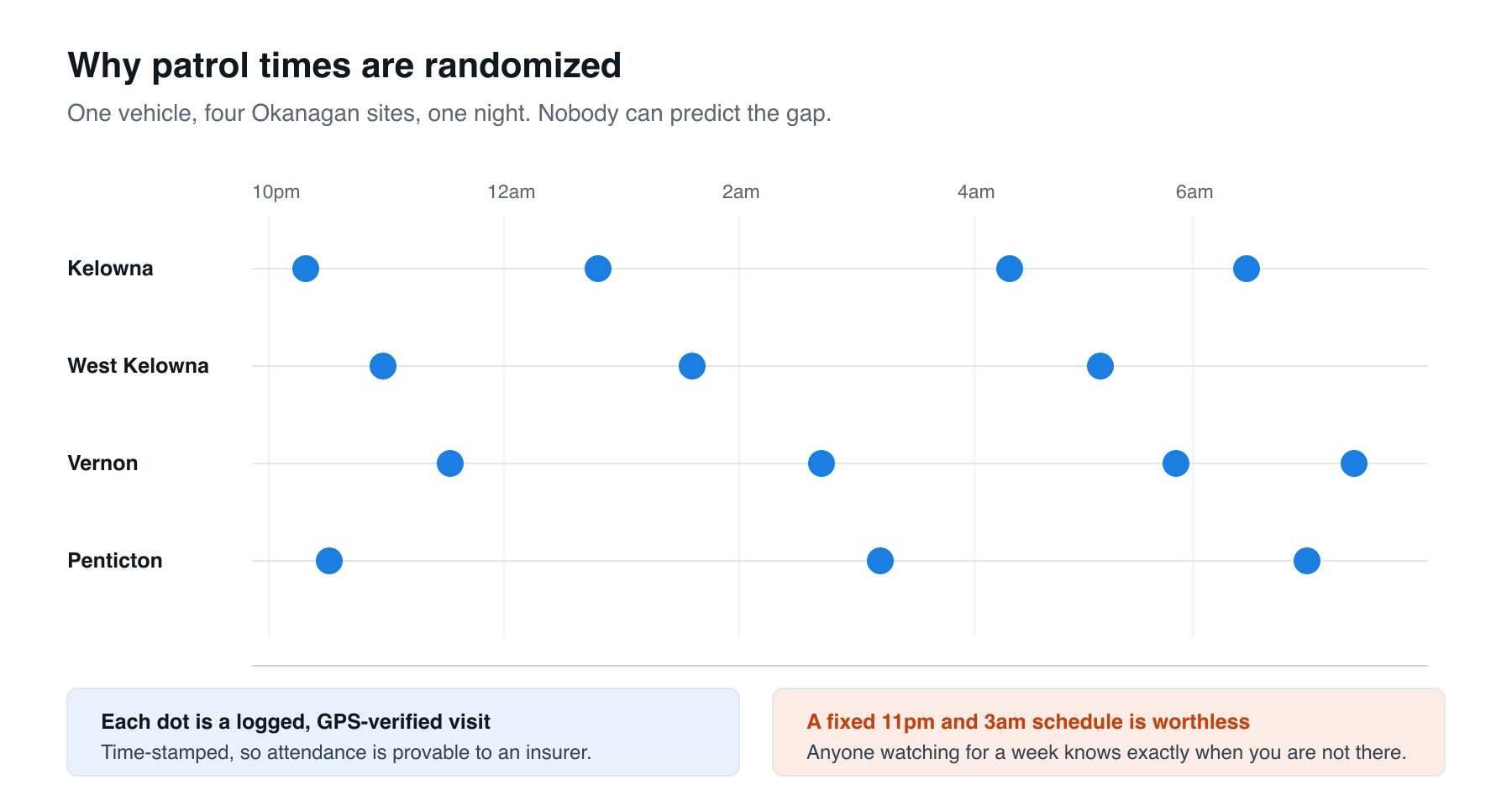
The randomization is the entire mechanism. A patrol that arrives at 11pm and 3am every night has published its own schedule. Anyone watching for a week knows exactly when the property is unwatched, and the patrol has become a timetable rather than a deterrent.
What a patrol visit should include
"We drove past" is not a patrol. A proper visit means the officer leaves the vehicle and checks the things that actually fail:
- Perimeter and access points. Gates, fences, doors, ground-floor windows.
- Any change since the last pass. Vehicles that were not there, doors now open, damage, lighting that has failed.
- Interior checks where the contract includes keys.
- Vulnerable areas specifically. Equipment compounds, fuel stores, material stockpiles, loading bays.
- A logged, time-stamped record with GPS verification and photographs of anything notable.
That last point is what you are really buying. If a claim, a dispute or a police report follows, the patrol log is the evidence that coverage existed and what condition the site was in.
Where patrol earns its cost in the Okanagan
Construction sites. Consistent development across the valley and consistently targeted. Copper, tools, fuel and appliances all move easily. Our construction site theft piece covers the real cost stack, which runs far beyond the value of what was taken.
Industrial and storage. Yards and warehouses holding stock in buildings empty overnight.
Retail after hours. Closed units where the risk is entry attempts and overnight sheltering in doorways and loading bays.
Strata parkades. The recurring complaint in almost every residential building. A randomized overnight pass costs a fraction of staffing the lobby. See our strata security guide.
Vacant and transitional property. Buildings between tenants, which the valley has a steady supply of, and where insurers frequently attach conditions.
Seasonal closures. Tourism-facing businesses shut for the off-season still hold stock and plant.
Fire watch, and when it stops being optional
Fire watch is a different service that often shares a vehicle with patrol.
It is required, rather than advisable, in defined circumstances. The common triggers:
- A fire alarm or sprinkler system is impaired, whether for maintenance, a fault or construction work. The building does not stop being occupied because the system is down, so a person substitutes for it.
- During and after hot work. Welding, cutting and grinding require a watch during the work and for a defined period afterwards, because ignition is frequently delayed.
- When an authority having jurisdiction requires it, which can follow an inspection or a deficiency notice.
- When an insurer attaches it as a condition, which is increasingly common on vacant property.
A fire watch means continuous, documented patrols at defined intervals, with a written log recording each round, and someone competent to raise the alarm and initiate evacuation. Our fire watch guide covers intervals, logs and who may perform it.
The log is not paperwork. It is the record that demonstrates the requirement was met, and it is the first thing requested if there is a fire or an insurance question afterwards.
Wildfire season across the valley
The Okanagan adds a layer that most of BC does not carry to the same degree.
During and after wildfire season, three things tend to happen at once: properties get evacuated and stand empty, alarm systems and utilities are disrupted, and insurers pay closer attention to whether premises were monitored.
Evacuated commercial premises are exposed in a way that is easy to underestimate. The area is quiet, response is stretched, and the buildings are known to be empty. Patrol coverage during an evacuation order, where access permits, is both a theft-prevention measure and documentation that the property was attended.
Our wildfire season security checklist sets out what to do before and during.
Coverage across the valley
Response time is the thing to establish, because the valley is long and a provider based at one end is not equivalent to one with officers across it.
- Kelowna is the largest concentration of commercial, retail and residential work, and our head office is here at 575 Hollydell Rd. See Kelowna.
- West Kelowna carries construction and residential development, and sits on the wildfire-exposed side of the lake.
- Vernon covers industrial, agricultural and commercial property. See Vernon.
- Penticton and the south valley cover tourism, retail and seasonal closures. See Penticton.
- Lake Country, Oliver and Enderby round out the corridor. See all locations.
Ask any provider where the officer covering your site is actually based, and what the realistic response time is at 3am rather than the advertised one.
What to ask before signing
1. How many properties does one vehicle cover per night? Too many and your site gets a drive-past rather than a check.
2. Are visit times genuinely randomized? Ask how, and ask to see logs demonstrating it.
3. What does the log show? GPS-verified time stamps and photographs, delivered promptly, not a monthly summary.
4. Are your guards licensed, and is the company? Both are required under the Security Services Act.
5. What is your fire watch capability? Not every patrol provider can staff a continuous watch at short notice, and short notice is exactly when you will need it.
6. What insurance do you carry? Ask for the certificate. Fireball Security carries $2M CAD in comprehensive general liability.
Frequently asked questions
1. What is a mobile patrol?
A licensed officer attending your property several times per shift in a marked vehicle, at randomized intervals, checking the perimeter and access points and logging each visit with GPS verification.
2. How often will a patrol visit my property?
It depends on the contract, commonly two to four times a night. What matters more than frequency is that the timing varies, so the pattern cannot be predicted.
3. Is mobile patrol cheaper than a static guard?
Considerably, because the vehicle and officer are shared across several sites. The trade-off is the gap between passes, which is acceptable for empty property and not for sites with people on them. Our comparison covers the decision.
4. When is a fire watch legally required in BC?
Most commonly when a fire alarm or sprinkler system is impaired, during and after hot work, or when an authority having jurisdiction or an insurer requires it. Our fire watch guide covers the detail.
5. Can the same provider do both patrol and fire watch?
Usually, and it is worth confirming before you need it. Fire watch requirements tend to arrive at short notice.
6. Do you cover Vernon, Penticton and West Kelowna as well as Kelowna?
Yes. Coverage runs the length of the valley, and the question to ask any provider is where the officer on your site is actually based.
7. What happens during a wildfire evacuation?
Where access permits, patrol coverage of evacuated premises both deters theft and documents that the property was attended, which matters for insurance afterwards.
Getting coverage in place
If you have a site standing empty overnight, or a sprinkler impairment coming up, the useful conversation is a short one about the specific property rather than a general quote.
Fireball Security has operated across British Columbia since 2020, serving 100+ clients in 11 cities with a roster of 100+ licensed guards. See our mobile patrol service, request a quote, or call 250-899-6620.