A shopping centre is not one security problem. It is forty tenants with different risks, a parkade, a food court, and a set of corridors that belong to nobody in particular.
That shared space is where most incidents happen, and it is usually the part nobody has thought about properly.
The four zones
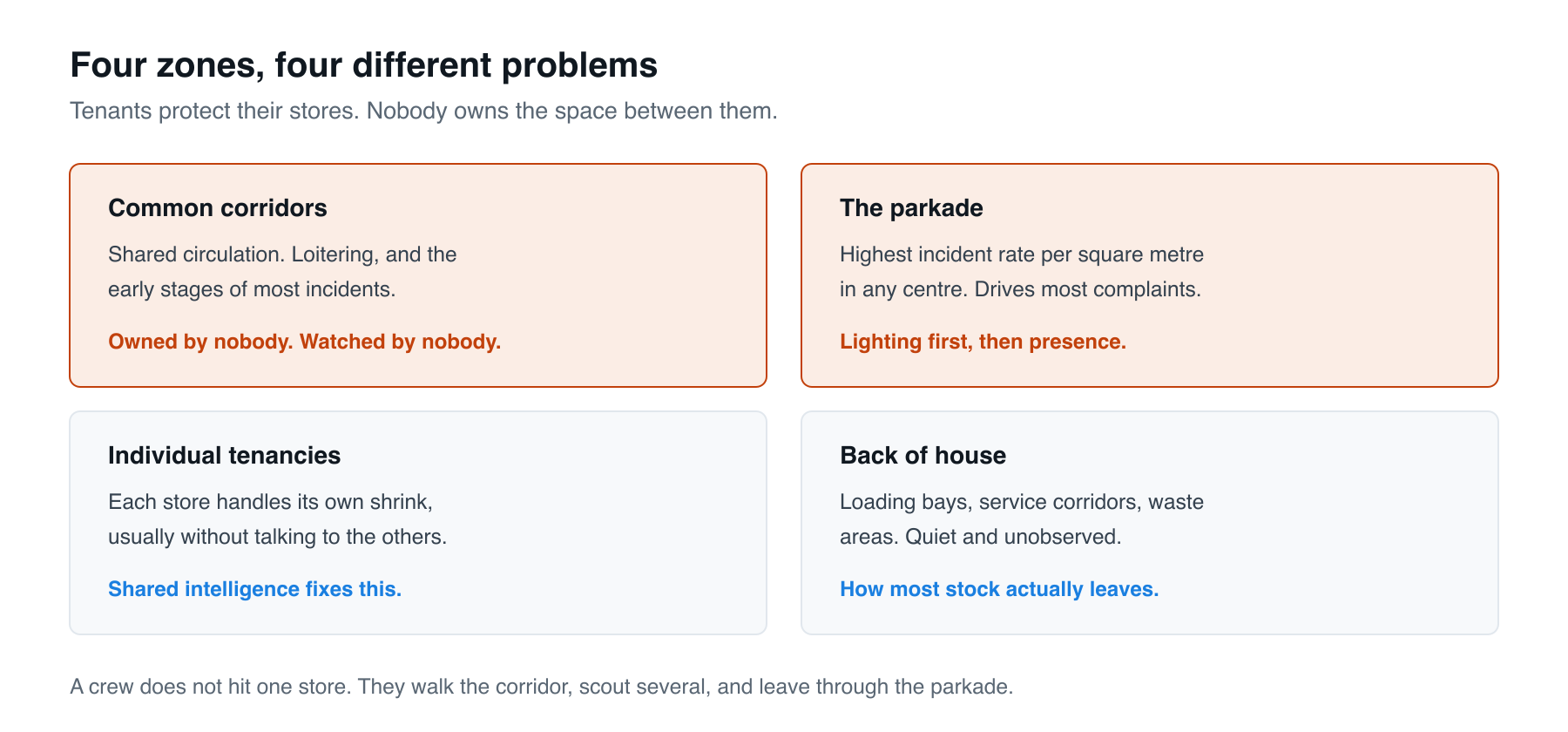
Entrances and common corridors. The shared circulation. This is where loitering, panhandling and the early stages of most incidents play out.
The parkade. Consistently the highest incident rate per square metre in any centre. Vehicle break-ins, catalytic converter theft, and the after-dark safety concerns that drive complaints from staff and shoppers.
Individual tenancies. Each store manages its own shrink. Our retail loss prevention guide covers that side, and organized retail crime covers crews working multiple stores.
Back of house. Loading bays, service corridors, waste areas. Quiet, unobserved, and the route most stock leaves by.
Why the corridor matters most
Tenants protect their own stores. Nobody owns the space between them.
A crew working a centre does not hit one store. They walk the corridor, scout several, and leave through the parkade. Every tenant sees a small loss. The centre sees a pattern, if anyone is looking.
That is the single biggest advantage a centre has over an individual retailer, and most centres waste it.
A guard who walks the corridors, notices the same three people on their second visit this week, and writes it down gives every tenant something no individual store can buy.
Shared intelligence beats more cameras
Four stores sharing descriptions in real time will stop a crew faster than four stores each buying another camera.
The mechanism is simple. Organised crews return. Recognition on the second visit prevents the third.
What that needs in practice:
- A log of incidents and attempts, including the ones where nothing was taken
- Descriptions and times, shared between tenants
- Someone whose job it is to notice the pattern
- A relationship with local police that is not built during an emergency
Centre management is the only party positioned to run this. Security is the obvious vehicle for it.
Parkade coverage
Parkades generate complaints out of proportion to their incident count, because people feel unsafe there even when nothing has happened.
Three things change that, roughly in order of cost:
Lighting. Dead bulbs in a parkade are the cheapest security failure to fix and the most commonly ignored.
Sightlines. Mirrors on blind corners, and nothing stacked against pillars.
Presence. A patrol pass at varied times, logged. For most centres, randomised passes work better than a fixed patrol schedule that everyone can time.
Our parking enforcement and parkade security guide goes deeper.
What guards can and cannot do
Worth being clear, because this is where centres get exposed.
Security officers in BC are licensed under the Security Services Act. They are not police.
They observe, document, deter by presence, control access, and ask people to leave. They can provide evidence to police.
Citizen's arrest exists in narrow circumstances but carries real liability, and a wrongful detention costs far more than the merchandise. Any provider marketing aggressive intervention is selling you risk.
Ask what their written policy is on detention and pursuit before you engage them. Our guard duties article sets out the limits.
Coverage that fits trading hours
Most centres do not need identical coverage all day.
Mornings are quiet. Afternoons and early evenings carry the shrink and the incidents. Closing is when the parkade matters. Overnight is a patrol problem, not a staffing one.
A sensible pattern for a mid-size BC centre: a visible officer through the busy trading hours, closing coverage focused on the parkade, and randomised overnight patrol passes.
That costs considerably less than a continuous post and works better, because the people are deployed where the risk actually is.
Talk to us
Fireball Security works with retail and property management clients across British Columbia, including centres on Vancouver Island and through the Okanagan. We have operated since 2020, with 100+ licensed guards serving 100+ clients in 11 cities, and $2M CAD in comprehensive general liability.
Tell us about your centre or call 250-899-6620.