
A static guard is a licensed security officer who stays on your site for the length of a shift. No route, no vehicle, no other properties. One person, one location, for every hour you book.
It is the oldest and simplest security service, the most expensive per site, and the one most often bought when something cheaper would have done the job. This guide covers what a static guard actually does, when the cost is justified, and how to tell whether your property needs one.
What a static guard does on shift
Most people picture someone standing by a door. The reality is closer to a repeating cycle.
- Access control. Checking who comes in, signing visitors and contractors, issuing passes, and stopping people who should not be there without turning it into a confrontation.
- Interior and perimeter patrols. Walking the property on a varied route, checking doors, windows, plant rooms and anywhere someone could conceal themselves.
- Deterrence by visibility. A guard who is seen paying attention prevents attempts that never get recorded. It is the most valuable part of the job and the hardest to prove.
- Response. When something happens, they are already there. That is the whole point of the service.
- De-escalation. Talking situations down. In practice this is what separates a good guard from a warm body.
- Documentation. Logging what happened, with times and photographs. Without records you cannot evidence anything to an insurer or a court.
- Opening, closing and key holding where the contract includes it.
Our guard duties and responsibilities article covers the scope, and importantly the legal limits, in more detail.
When a static guard is the right answer
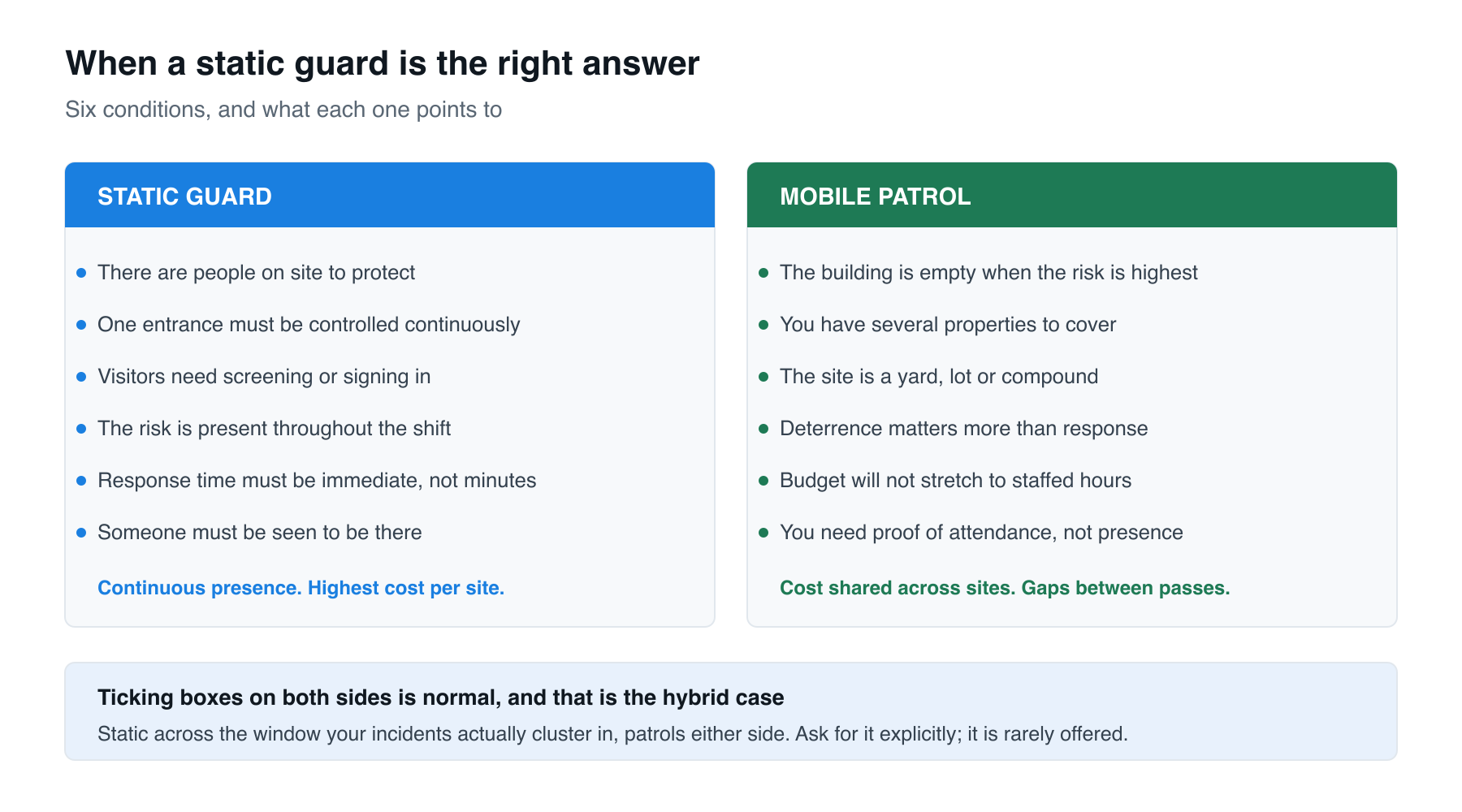
The honest test is whether the risk is continuous or intermittent.
A guard on site is continuous coverage. If your exposure is a two-hour window at closing, you are paying for eight hours to cover two. If your exposure runs the whole shift, or there are people on site who might need help at any point, continuous is exactly what you want.
The strongest cases for static coverage:
- People are on site and the risk is to them, not just to property
- A single entrance must be controlled and documented continuously
- Visitors need screening rather than counting
- Response has to be immediate, because minutes matter
- The deterrent needs to be seen, which a patrol passing four times a night cannot deliver
- An insurer or regulator has attached a condition requiring attendance
When it is the wrong answer
Being straight about this matters more than the sales pitch.
An empty building overnight rarely needs a static guard. There is nobody to protect and nothing happening for most of the shift. Mobile patrol delivers most of the deterrence at a fraction of the cost, because the vehicle and officer are shared across several sites.
A yard, lot or compound is usually patrol territory for the same reason. One person cannot meaningfully cover a large open area continuously anyway.
A short, predictable risk window does not justify a full shift. If everything happens between 11pm and 1am, cover that.
A lighting or hardware problem is not a staffing problem. A proper site assessment sometimes concludes that a rekeyed door, a fixed fence line and better lighting solve the issue for a fraction of what a guard costs. A provider willing to say so is worth more than one who quotes guards for everything.
Static, mobile, or both
The comparison is covered in full in static guards versus mobile patrols, but the short version:
Static buys continuous presence and immediate response, at the highest cost per site.
Mobile buys deterrence and provable attendance at intervals, at much lower cost, with gaps between passes.
Hybrid puts a static guard across the window your incidents actually cluster in and patrols either side. For a lot of businesses this is the correct answer and nobody offers it unless asked, because a single continuous post is simpler to quote and larger to invoice.
If you do not know when your incidents cluster, that is the first thing to establish. A fortnight of patrol reports will usually tell you.
What a static post costs in BC
Licensed static guarding through a properly insured BC company generally starts around $28 an hour and runs upward depending on hours, notice and site complexity. Overnight, weekend and statutory holiday coverage costs more. Our security guard cost guide breaks it down.
Two things drive the total more than the rate:
- Shift length. Four hours is the standard minimum, so a two-hour requirement still bills at four.
- Continuity. Ongoing contracts price better per hour than sporadic bookings, because the provider can roster properly.
A rate materially below the market is a signal, not a bargain. Guards must be licensed, and a licensed company must carry insurance, run supervision and pay enough to retain people. Well under $28 an hour usually means underpaid guards who churn, thin insurance, or work quietly subcontracted to a company you never vetted.
Making a static post actually work
Static coverage fails in the first fortnight more often than at any later point, and almost always for the same reason: the guard was never properly briefed.
Write post orders. What to check, in what order, what to do when something is wrong, and who to call at 2am. Without them the guard invents a routine, and the routine will not match your priorities.
Walk the site with them before the first shift. A guard who has had the building explained catches things a stranger cannot.
Introduce them to your staff. A guard nobody knows is a stranger in the building, which undermines the entire point.
Insist on varied patrol timing. A guard who walks the same route at the same times has told anyone watching exactly when each area is unwatched.
Read the reports. They are the product you are buying. If they are thin, that is a supervision problem and you should raise it early.
Review at two weeks. The first fortnight of reports frequently shows the risk sits an hour either side of where you assumed, and the shift should move accordingly.
Frequently asked questions
1. What is a static guard?
A licensed security officer who remains at one site for the duration of a shift, controlling access, patrolling internally, deterring by presence, responding to incidents and documenting what happens.
2. What is the difference between a static guard and a mobile patrol?
A static guard stays on your property throughout the shift. A mobile patrol attends several times a night at randomized intervals and covers other client sites in between. Static gives continuous presence at higher cost; mobile gives deterrence and documented attendance at lower cost.
3. How much does a static guard cost in BC?
Generally from around $28 per hour upward, depending on hours, notice and site complexity, with a four-hour minimum shift standard across the province.
4. Do I need a static guard for an empty building?
Usually not. With nobody on site, mobile patrol delivers most of the deterrent value at a fraction of the cost. Static makes sense when there are people to protect or a point to control continuously.
5. Are static guards licensed in BC?
They must be. Both the individual guard and the company employing them require current licences under the Security Services Act. Ask for both and verify them.
6. Can one static guard cover a large site?
Only to a point. Beyond a certain size one person cannot both cover the property and respond, and you need either more guards or a patrol pattern instead of a fixed post.
7. What should a static guard produce for me?
Attendance records, patrol logs, and incident reports with photographs delivered promptly rather than summarized at month end. If a dispute or insurance claim follows, the report is the evidence.
Getting a static post quoted properly
Tell providers when your incidents happen, not just that you want a guard. The window matters more than the headcount, and it is where the money is saved.
Fireball Security has operated across British Columbia since 2020, serving 100+ clients in 11 cities with a roster of 100+ licensed guards. Every officer is licensed, every site gets GPS-verified reporting, and we carry $2M CAD in comprehensive general liability.
Request a quote and we will come back within 60 minutes during business hours, or call 250-899-6620.