

Plenty of BC buildings have someone at the front desk. Fewer have thought about what that person is actually for.
The question matters because a receptionist and a concierge security officer look almost identical from the lobby. They greet people, sign for parcels, direct visitors and manage the desk. The difference only becomes visible at the moment something goes wrong, and by then the choice has already been made.
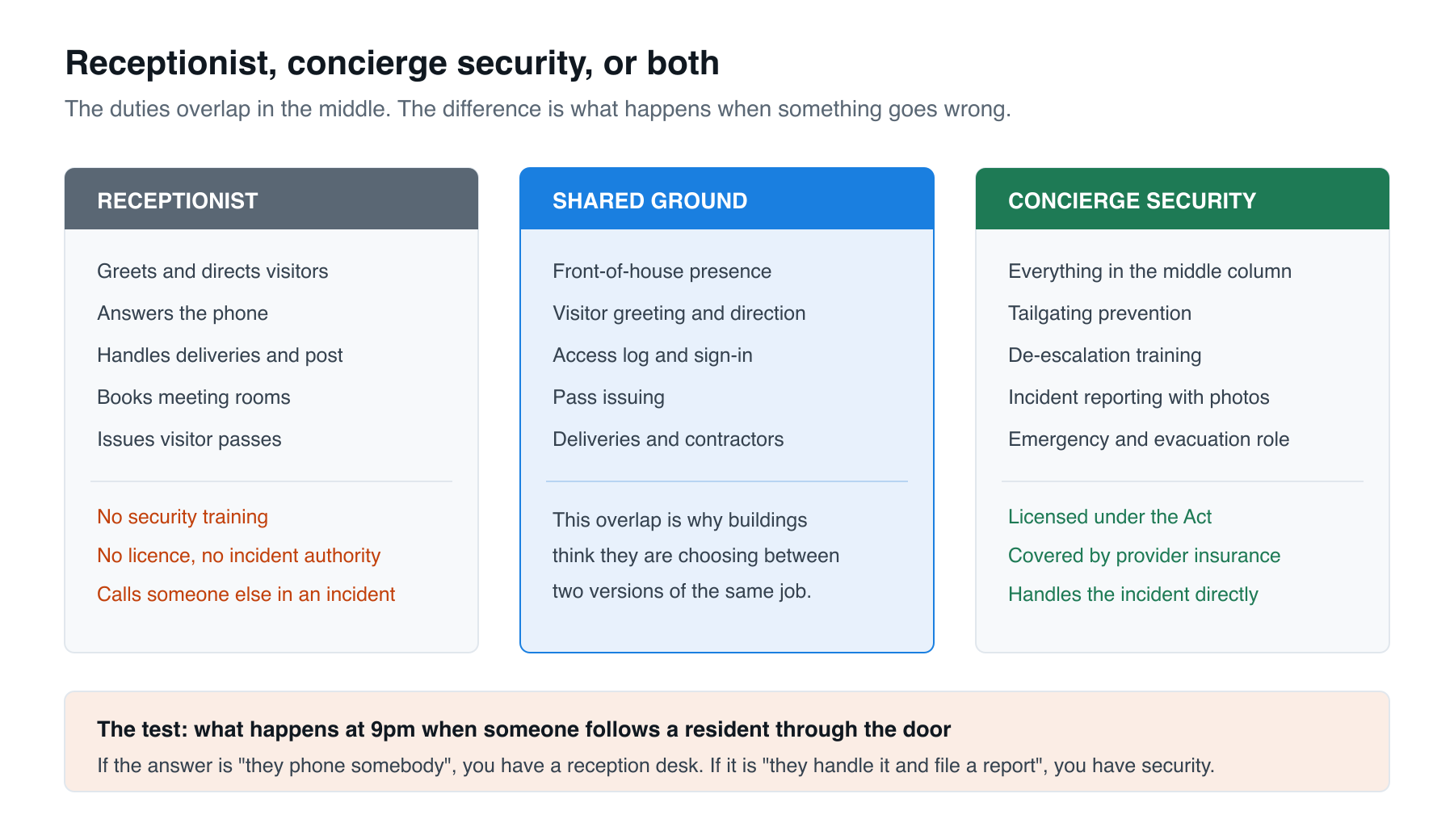
The overlap is real
Worth acknowledging honestly, because it is why the decision confuses people.
A good receptionist and a good concierge security officer do most of the same things for most of the day. Greeting, directing, signing in, issuing passes, managing deliveries, handling contractors. On a normal Tuesday there is no visible difference.
That overlap is exactly what makes the choice feel like it is between two versions of one job. It is not.
Where they diverge
Three things separate them, and none is visible until they are needed.
Training. A concierge security officer completes Basic Security Training, which covers de-escalation, observation and reporting, legal authority and its limits, and emergency procedure. A receptionist has none of that unless someone provided it separately.
Licensing and authority. Concierge security is licensed work under the Security Services Act. The officer holds a worker licence, works for a licensed business, and operates within a defined scope. A receptionist has the authority any employee has, which is to ask and then to call someone.
What happens in an incident. This is the whole thing. A receptionist's correct procedure is to escalate. A concierge security officer's is to handle it: intervene appropriately, de-escalate, document with photographs, and escalate only when the situation warrants.
The test that settles it
Picture 9pm on a weekday. Someone follows a resident through the door behind them without using a fob.
If your front-desk person's correct response is to phone somebody, you have a reception desk. That is a legitimate choice, but you should know you have made it.
If their correct response is to approach, establish who the person is, and either admit or remove them, then file a report, you have security.
Tailgating is worth using as the test because it is the single most common way controlled buildings get breached, and no access control hardware prevents it. Our access control and concierge security piece covers why the hardware layer fails without people.
What a concierge security officer does that a receptionist cannot
- Prevents tailgating by noticing it and addressing it, which requires both the training to intervene and the standing to do so.
- De-escalates an angry resident, an intoxicated visitor or a dispute in the lobby, without it becoming an incident.
- Documents properly. Incident reports with times, descriptions and photographs, which is what an insurer, a strata council or a court will later ask for.
- Handles the emergency role. Evacuation procedure, first response, coordinating with attending services.
- Enforces building rules with the authority of a licensed officer rather than the awkwardness of a colleague.
- Manages contractors and access to plant rooms, parkades and restricted floors.
Where each one fits
A receptionist is the right hire when the desk is genuinely a service function, the building has low foot traffic and known occupants, access is controlled adequately by hardware, and there is a security arrangement elsewhere.
Concierge security is the right hire when the desk is the building's main vulnerability as well as its front of house. That is most commonly:
- Strata and residential towers, where the parkade and lobby generate the recurring council complaints. Our strata security guide covers the wider picture.
- Hotels, where guest service and incident handling have to coexist in the same person.
- Corporate lobbies with visitor volume, contractors and restricted floors.
- Mixed-use buildings where retail, residential and commercial traffic share an entrance.
Both is the answer for larger buildings. A receptionist handling service during business hours and a licensed officer covering evenings, nights and weekends is a common and sensible split, because the risk profile of a lobby at 2pm and at 2am are not the same thing.
What it costs, honestly
Concierge security prices at the lower end of the guarding range, generally from around $28 an hour, because it is not high-risk work and continuity keeps the rate competitive. Our cost guide sets out the range across services.
Compared against employing a receptionist directly, the hourly figure looks higher. It is not comparing like with like. The contract rate includes licensing, supervision, relief coverage when the person is sick, insurance and reporting infrastructure. An employed receptionist's wage includes none of those, and the relief problem in particular tends to be discovered rather than planned for. Our in-house versus contract comparison works through the full stack.
Making it work in practice
The failure mode for concierge security is not incompetence. It is the officer being treated as furniture.
- Write post orders covering the building specifically: which doors, which floors, which contractors are expected, what the escalation path is after hours.
- Introduce them to residents or staff. A concierge nobody knows cannot do the service half of the job, and the service half is what makes the security half possible.
- Decide the rules in advance. What happens when a resident insists on admitting a guest who is not on the list. The officer needs to know your answer, not invent one.
- Read the reports. They are the record of what the desk is actually dealing with, and they usually reveal that the problems are not the ones you assumed.
- Keep the same officer where you can. Continuity is worth more at a front desk than anywhere else in security, because recognition is the job.
Frequently asked questions
1. What is concierge security?
Front-of-house coverage by a licensed security officer who performs reception duties and is also trained to prevent tailgating, de-escalate incidents, document them and handle emergency procedure.
2. How is concierge security different from a receptionist?
The duties overlap heavily day to day. The difference is training, licensing and what happens in an incident: a receptionist escalates, a concierge security officer handles it and files a report.
3. Do concierge security officers need a licence in BC?
Yes. It is licensed work under the Security Services Act, requiring an individual worker licence and a licensed security business employing them.
4. Is concierge security more expensive than a receptionist?
The hourly rate is higher, but it includes licensing, supervision, relief coverage, insurance and reporting. An employed receptionist's wage covers none of those, and you absorb the relief problem yourself.
5. Which buildings need concierge security rather than reception?
Strata and residential towers, hotels, corporate lobbies with visitor volume, and mixed-use buildings. Broadly, anywhere the front desk is both the service point and the main vulnerability.
6. Can one person cover both roles?
That is precisely what a concierge security officer is. The point of the role is that service and security are the same person rather than two hires.
7. Does concierge security stop tailgating?
It is the only thing that reliably reduces it. Access hardware cannot detect someone walking in behind an authorised person; a trained officer at the desk can.
Working out which you need
Run the 9pm test on your own building. If the honest answer is that your front desk would phone somebody, decide deliberately whether that is acceptable.
Fireball Security has operated across British Columbia since 2020, serving 100+ clients in 11 cities with a roster of 100+ licensed guards. See our concierge and front-desk service, request a quote, or call 250-899-6620.