

Everyone who works as a security guard in British Columbia starts in the same place: Basic Security Training, followed by an exam. Get through both, clear a criminal record check, and you can apply for a worker licence.
This guide covers what BST involves, what the exam tests, what it costs, and how long the whole thing realistically takes. If you already hold a licence and simply need to keep it, our renewal guide is the one you want.
The path from nothing to working a shift
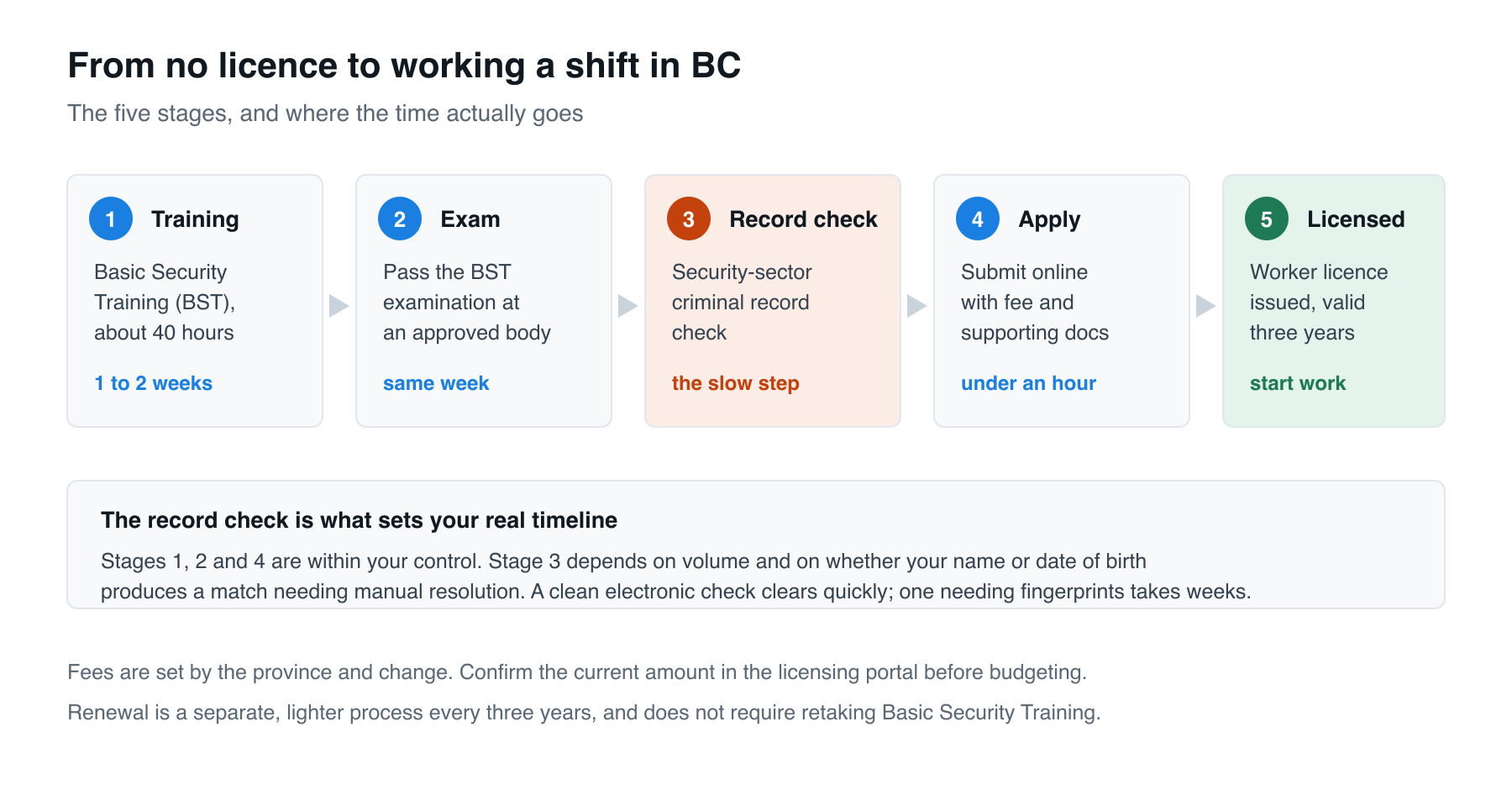
Four of those five stages are within your control. The record check is not, and that is what determines your real timeline.
What Basic Security Training covers
BST is the mandatory entry course for the BC security worker licence. It runs in the region of 40 hours, delivered in class or online depending on the provider, and it is not a formality you sit through.
The material covers the things a guard is legally and practically expected to know:
- The legal framework. The Security Services Act and Regulation, what a licence permits, and the limits on a guard's authority. This is the part new guards most often underestimate.
- Powers and their limits. What you may and may not do, including where citizen's arrest sits and why it carries serious risk.
- Observation and reporting. How to record what happened accurately enough that it survives scrutiny later. In practice this is the single most valuable skill on the job.
- Use of force and de-escalation. Overwhelmingly weighted toward avoiding force.
- Emergency response. Fire, medical, evacuation.
- Professional conduct. Bias, discrimination, privacy, and how a guard is expected to behave.
The bias here is deliberate. Most of a guard's working life is watching, documenting and talking, and the training reflects that rather than the version of the job people imagine.
The exam
You sit an examination through an approved body once the coursework is done. It is knowledge-based rather than practical, and it concentrates on the legal and procedural material.
Candidates who struggle usually do so on the same things:
- Authority limits. Precisely what a guard may do, and what only police may do.
- Report writing. Distinguishing what you observed from what you concluded.
- Statutory detail. Specific provisions rather than general principles.
If you have worked security in another province or another country, do not assume the material transfers. BC's framework is its own, and confident guessing based on experience elsewhere is a common way to fail.
The Justice Institute of British Columbia
The Justice Institute of British Columbia (JIBC) is the provider most people search for by name, and it is a well-established route. It is not the only one. The province maintains the list of approved training organisations, and providers differ in schedule, delivery format and price.
Two things worth doing before you book:
- Confirm the provider is currently approved. A course from an unapproved organisation will not support your application.
- Check the delivery format honestly against yourself. Online is flexible; in-person suits people who need structure and want to ask questions in the room.
What it costs
Budget for three separate costs, not one:
- The training course. Set by the provider and the largest single item.
- The criminal record check. Charged separately.
- The licence fee. Set by the province. As a planning figure, BC security worker licence fees have generally sat in the range of roughly $60 to $240 depending on licence type and term.
Fees change, so confirm the current figures with your training provider and in the licensing portal before committing.
Before you pay for any of it, talk to employers. Some licensed security companies subsidise or reimburse training for people who commit to working with them. That conversation is worth having first, because it can remove the largest cost entirely.
Applying for the licence
With training and the record check done, the application itself is straightforward and mostly administrative.
1. Create your account in the province's online licensing system, and use one account throughout. Duplicate accounts create file problems that take far longer to unwind than a password reset.
2. Enter your details accurately. Legal name, date of birth, current and previous addresses. Errors here are the most common reason a file goes back.
3. Attach your training record and complete the record check as directed in the portal. Do not substitute a generic police check obtained independently; it is often not the type required, and you will have paid for the wrong document.
4. Declare anything relevant. Charges and convictions must be disclosed even where you believe them irrelevant or where the matter resolved in your favour. Non-disclosure is treated far more seriously than the underlying matter usually is.
5. Pay and submit, then watch the email address on file, including the spam folder, for follow-up requests.
Realistic timelines
Training and exam can be done inside two weeks if a course is running when you need it. The record check is the variable, and it is genuinely unpredictable: a clean electronic check clears quickly, while one requiring fingerprint resolution can take weeks.
Plan for around four to eight weeks from starting the course to holding the licence, and treat anything faster as a bonus. If you are giving notice at another job, do not do it on the assumption of the fast case.
Is the work worth it
Worth being straight about what the job actually is.
Much of it is uneventful by design. A shift where nothing happens is a shift that went well. The work suits people who are observant, reliable, calm under pressure and able to write clearly. It does not suit people looking for confrontation, and providers screen for that.
Pay in BC generally starts in the low-to-mid twenties per hour and rises with responsibility, licence tenure and shift pattern. Our guide to becoming a security guard in BC covers pay and progression in more detail, and what guards actually do on shift sets out the day-to-day.
The realistic route to better earnings is a company with long-term commercial contracts rather than short-term event bookings, because scheduling stability matters more than the headline rate.
Frequently asked questions
1. How long is Basic Security Training in BC?
In the region of 40 hours, delivered in class or online. Most people complete it within one to two weeks depending on the schedule they choose.
2. Do I need to pass an exam to get a BC security licence?
Yes. You complete BST and then sit an examination through an approved body. The exam is knowledge-based, weighted toward the legal framework and reporting.
3. Is JIBC the only place I can train?
No. The Justice Institute of British Columbia is the best known, but the province approves multiple training organisations. Confirm any provider is currently approved before booking.
4. What does it cost to get a security licence in BC?
Three separate costs: the training course, the criminal record check and the provincial licence fee. Licence fees have generally sat in the range of roughly $60 to $240 depending on type and term. Confirm current figures before budgeting.
5. How do I apply for a security licence in BC?
Through the province's online licensing system, after completing training and the record check. You will need photo identification, your address history, your training record and a payment method.
6. How long does the whole process take?
Realistically four to eight weeks. Training and the exam are quick; the criminal record check is the unpredictable part.
7. Will an employer pay for my training?
Sometimes. Some licensed companies subsidise or reimburse training for people who commit to working with them. Ask before paying out of pocket.
8. Does a criminal record automatically disqualify me?
No. Not every charge or conviction is disqualifying, and relevance to security work is assessed. Failing to disclose causes far more problems than the underlying matter usually does.
Once you are licensed
Getting the licence is the start. What follows is finding an employer with consistent work rather than sporadic shifts.
Fireball Security has operated across British Columbia since 2020 and runs a roster of 100+ licensed guards serving 100+ clients in 11 cities. If you are newly licensed or working toward it, our careers page lists what we have open, and we are happy to talk to people still in training.