

It is the question people are most afraid to ask, and the one they most often get wrong by guessing: does a criminal record stop you getting a BC security worker licence?
The short answer is no, not automatically. The longer answer is that how you handle it matters more than what is on it.
There is no automatic bar
British Columbia does not publish a list of offences that permanently disqualify you from holding a security worker licence. Applications are assessed, and the assessment is about relevance to security work rather than about whether you have ever been in trouble.
That is a meaningful distinction. People talk themselves out of applying because they assume any record ends the conversation. It does not. Plenty of licensed guards in BC have something in their history.
What actually gets weighed
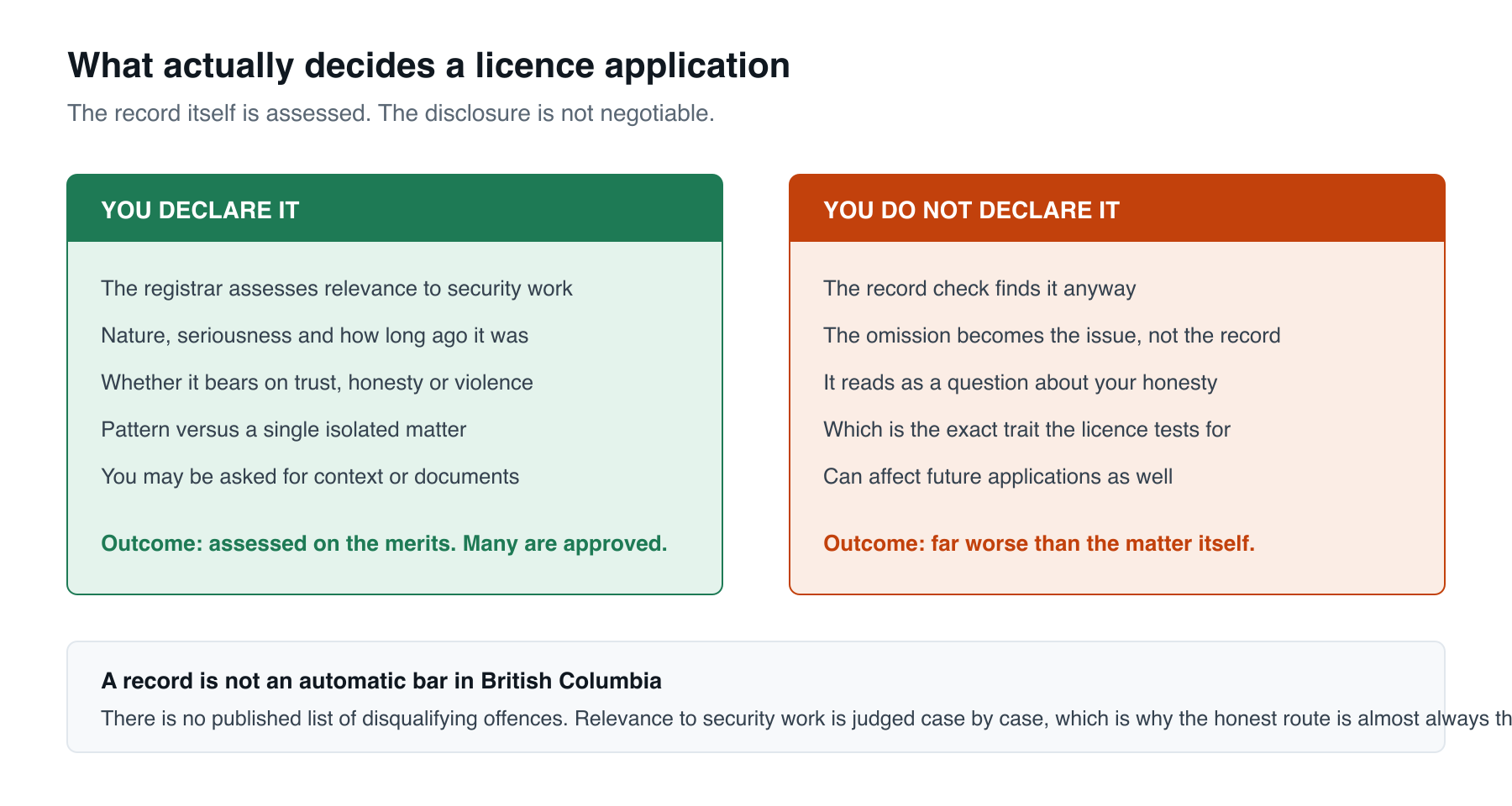
The registrar is trying to answer one question: does this person's history suggest a risk in a role that involves trust, access and authority over other people?
The things that bear on that:
- What the offence was. Matters involving dishonesty, violence, or abuse of a position of trust weigh more heavily than something unrelated to the work.
- How long ago. A matter from fifteen years ago reads very differently from one from last year.
- Whether there is a pattern. A single isolated incident is assessed differently from repeated matters.
- What happened since. Employment history, stability, references, and whatever you can show about the intervening years.
- The outcome. A charge that did not result in a conviction is not the same as a conviction, though it may still need to be disclosed and discussed.
What does not help: arguing that it was unfair, or that it should not count. The assessment is about risk, not about relitigating the matter.
The part that is genuinely non-negotiable
Disclose it.
The record check will find what is there. If you have omitted something, the issue stops being the original matter and becomes the omission, and an omission in a licence application reads directly as a question about honesty. Honesty is close to the whole substance of what a security licence certifies.
This is the single most common way people turn a manageable situation into a refusal. The matter itself might have been assessed and approved. The non-disclosure rarely is.
If you are unsure whether something needs declaring, declare it. Over-disclosure costs you a conversation. Under-disclosure can cost you the licence and make future applications harder.
Things people are unsure about
A charge that was withdrawn or stayed. Not a conviction, but it may still appear and may still need disclosing. Declare it and explain the outcome.
A youth record. Treated differently in law, but do not assume it is invisible. Ask rather than guess.
A pardon or record suspension. Changes how a record is disclosed, but this is exactly the kind of detail worth confirming with the Security Programs Division rather than relying on a forum post.
Something from outside Canada. Expect additional checks and a longer timeline if you have lived abroad.
A pending matter. Something currently before the courts is a genuine complication, and the honest advice is to get clarity on your situation before paying for training.
Where to get a real answer
This article is a general explanation, not advice on your situation, and nobody on the internet can tell you how your specific file will be assessed.
Two things worth doing before you spend money on Basic Security Training:
1. Get your own record check first. Knowing exactly what is on it is better than guessing. It also means no surprises later in the process.
2. Ask the Security Programs Division directly. They administer the licensing scheme and can speak to how a situation is treated. A short enquiry before you commit to a course is time well spent.
If a matter is serious or recent, legal advice is worth more than anything you will read online.
What this means practically
For most people with something minor and historical in their past, the realistic position is that the licence is available, the process takes the normal four to eight weeks, and the record check is simply one more step. Our processing time guide covers that timeline.
For people with something recent, serious, or directly related to trust or violence, the honest answer is that it may well be a barrier, and finding that out before paying for a course is better than finding out after.
Either way the sequence is the same: find out what is on your record, disclose everything, and let the process work.
Frequently asked questions
1. Can I get a security licence in BC with a criminal record?
Often, yes. There is no automatic bar and no published list of disqualifying offences. Applications are assessed on relevance to security work, how long ago the matter was, whether there is a pattern, and what has happened since.
2. Do I have to disclose a charge that did not lead to a conviction?
Generally you should. A charge is not a conviction, but it may still appear and may still require disclosure. Declaring it and explaining the outcome is far safer than omitting it.
3. What happens if I just do not mention it?
The record check is likely to find it, and the omission then becomes the central issue. Non-disclosure is treated considerably more seriously than most underlying matters, and it can affect future applications too.
4. Which offences matter most?
Those bearing on trust, honesty, violence, or abuse of a position of authority, because those go directly to the risk the licence is meant to manage.
5. Does a pardon or record suspension help?
It changes how a record is disclosed, but the detail matters. Confirm your position with the Security Programs Division rather than assuming.
6. Should I pay for training before I know?
No. Get your own record check and ask the Security Programs Division first. Training is the largest single cost in the process and it is not refundable because an application was refused.
7. Will an employer see my record?
An employer sees whether you hold a valid licence. The detail of the assessment sits with the licensing authority, not with the company that hires you.
If you are licensed and looking for work
Fireball Security has operated across British Columbia since 2020 and runs a roster of 100+ licensed guards serving 100+ clients in 11 cities. We hire on reliability and temperament, and we are happy to talk to people still working through licensing.
Our careers page lists current openings, or call 250-899-6620.