

Security work in Kelowna is steadier than most people expect. The Okanagan runs on tourism, construction, hospitality and retail, and all four need coverage year-round rather than seasonally.
This guide covers what the jobs actually involve, what they pay, what shifts look like, and how to get hired, including what employers here are genuinely screening for.
What the work involves
The honest version: most shifts are uneventful, and that is the point. A night where nothing happens is a night that went well.
Depending on the assignment, the work is some combination of controlling access, patrolling a property on a varied route, monitoring for anything out of place, de-escalating situations before they become incidents, and writing it all down accurately. Our guard duties and responsibilities article sets out the day-to-day and the legal limits.
The assignments in the Okanagan break down roughly as:
- Construction and industrial sites, protecting equipment and materials overnight. Steady work, and the region has consistent development.
- Hospitality, covering hotels and resorts where guest service matters as much as security. Peaks in summer.
- Retail and commercial, including loss prevention work in stores and shopping centres.
- Strata and residential, covering lobbies and parkades in the growing number of Kelowna towers.
- Mobile patrol, covering multiple sites a night from a vehicle rather than staying in one place.
- Events, which is seasonal and useful for topping up hours.
What it pays
Guard pay in BC generally starts in the low-to-mid twenties per hour and rises with responsibility, licence tenure and shift pattern. Overnight, weekend and statutory holiday work carries premiums, and those premiums are where a lot of the actual earnings sit.
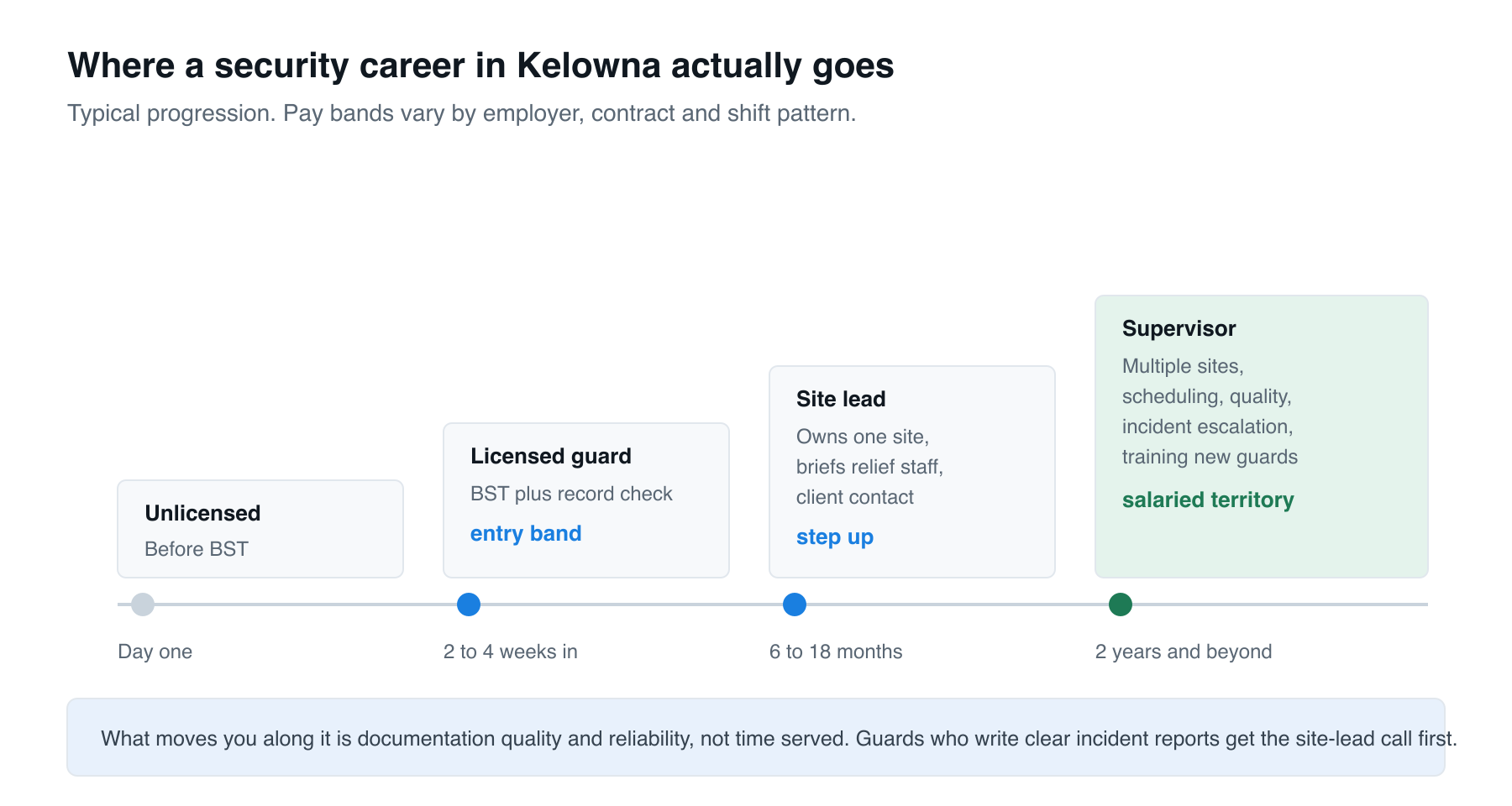
What moves you along that path is not time served. It is documentation quality and reliability. Guards who write clear, complete incident reports and turn up consistently get the site-lead conversation first, because those are the two things a supervisor cannot fix remotely.
Two practical points about earnings:
- Contract type matters more than hourly rate. A company with long-term commercial contracts offers consistent scheduling. Event-heavy work pays comparably per hour but delivers unpredictable weeks.
- Ask about guaranteed hours. "Up to 40 hours" and "40 hours" are very different propositions, and the difference will not show up in the advertised rate.
Getting licensed first
You cannot work a security shift in BC without a worker licence. The route is Basic Security Training, an exam, a criminal record check, then the application.
Realistically that takes four to eight weeks, most of it waiting on the record check. Our BST training and licence exam guide covers the process in full, and how to become a security guard in BC covers the wider picture.
Talk to employers before you pay for training. Some licensed companies subsidise or reimburse it for people who commit to working with them, which can remove the largest single cost. It is a conversation worth having first rather than after.
Once you hold a licence it runs for three years, and renewal is a lighter process that does not involve retaking the training.
What Kelowna employers actually screen for
Having hired across the Okanagan since 2020, the things that decide it are rarely the things applicants emphasise.
Reliability above everything. Security schedules have no slack. One person not arriving means a post is empty and a supervisor is driving across town at 3am. A candidate with an unremarkable record of turning up beats a more impressive CV with gaps.
Written English good enough for a report that holds up. Incident reports get read by insurers, strata councils and occasionally lawyers. This is a genuine screening criterion and it surprises people.
Calm rather than assertive. Candidates who present as wanting confrontation get screened out. The job is de-escalation, and a guard who escalates creates liability.
Availability that matches the roster. Overnight and weekend availability is worth more than daytime-only, because that is where the demand is and where the premiums are.
A vehicle and clean licence for mobile patrol roles specifically. Not required for static posts.
What matters less than applicants think: prior security experience. Employers will train the right temperament. They cannot train reliability.
Applying
1. Get licensed, or start the process. Applying with training underway is fine, and often welcome, since it shows commitment and lets an employer plan.
2. Apply directly to licensed companies rather than only through job boards. Verify the company holds a security business licence, which is a reasonable thing to ask.
3. Put availability at the top of your application. Specific days and hours, not "flexible." It is the first thing a scheduler looks for.
4. Be straightforward about your record. Not everything is disqualifying and relevance is assessed. Non-disclosure causes far more problems than disclosure does.
5. Ask about guaranteed hours, shift patterns, and whether uniform and training are covered. These are normal questions and a good employer answers them plainly.
Frequently asked questions
1. Do I need a licence to work security in Kelowna?
Yes. A BC security worker licence is required, and it means completing Basic Security Training, passing the exam and clearing a criminal record check first.
2. How much do security guards make in Kelowna?
Generally starting in the low-to-mid twenties per hour, rising with responsibility and licence tenure. Overnight, weekend and statutory holiday shifts carry premiums that meaningfully affect weekly earnings.
3. How long does it take to become a security guard?
Realistically four to eight weeks from starting training to holding a licence. The criminal record check is the unpredictable part.
4. Is security work in Kelowna seasonal?
Some is. Event and hospitality work peaks in summer. Construction, industrial, retail and residential coverage runs year-round, which is where the steady hours are.
5. Do I need experience?
No. Employers here generally train for the role and screen for temperament, reliability and written communication instead.
6. What shifts are available?
Overnight, evening, weekend and daytime, depending on the assignment. Overnight and weekend availability is the most in demand and carries the better premiums.
7. Will an employer pay for my training?
Some do, for candidates who commit to working with them. Ask before paying out of pocket.
8. Can I work security part time?
Yes. Many guards start part time around other commitments, and mobile patrol and event work in particular suit that.
Working with us
Fireball Security has operated across British Columbia since 2020, and Kelowna is our home base, with the head office at 575 Hollydell Rd. We run a roster of 100+ licensed guards serving 100+ clients across 11 cities.
We hire for reliability and temperament, we cover licence renewal fees for our team, and we would rather talk to someone still in training than miss them.
Our careers page lists current openings, or call 250-899-6620.