A vineyard is an unusual security problem. For part of the year it is an unstaffed agricultural site holding expensive machinery. For another part it is a hospitality venue serving alcohol to the public. Those need completely different coverage, and the switch happens on a predictable schedule.
This covers how Okanagan wineries and vineyards are exposed through the year, and what coverage actually fits each phase.
The risk changes four times a year
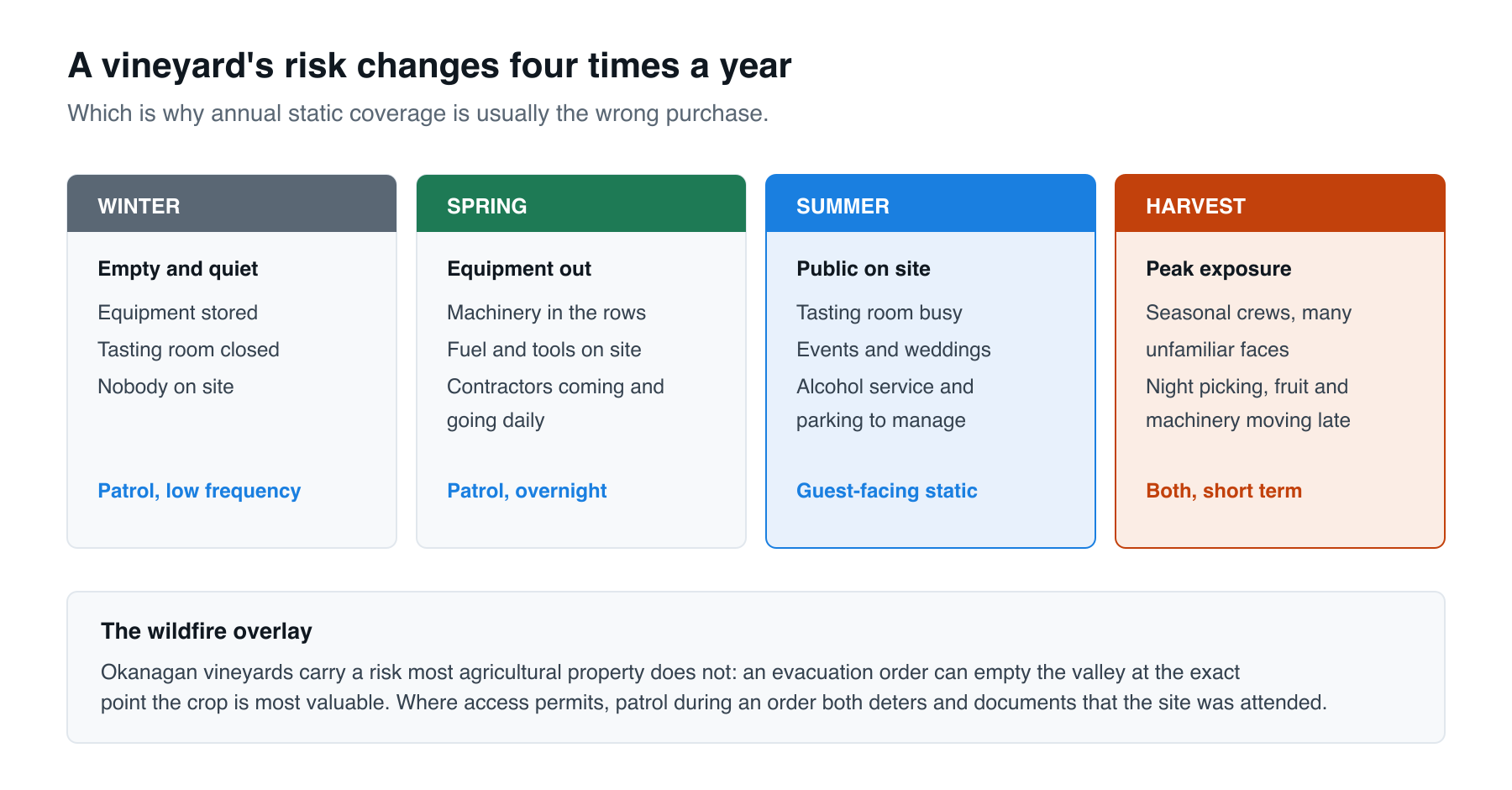
That shape is why annual static coverage is usually the wrong purchase for a winery. You would be paying hospitality-grade staffing through a winter when nobody is on site, and the same arrangement would be under-resourced at harvest.
Winter: empty and quiet
Equipment is stored, the tasting room is closed or on reduced hours, and for long stretches nobody is on the property.
What matters: the equipment shed, the fuel store and the building itself. What works: low-frequency mobile patrol with randomized timing and documented attendance. One or two passes a night costs a fraction of staffed coverage and gives you the logged record an insurer will want if something does happen.
Spring: equipment out, contractors in
Machinery moves into the rows. Fuel, tools and implements sit out where they are being used. Contractors and seasonal workers come and go daily, which means a lot of unfamiliar vehicles on the property legitimately.
That combination, valuable kit plus normalised unfamiliar traffic, is exactly the condition that makes theft easy. Somebody loading a quad onto a trailer at dusk does not look wrong.
What works: overnight patrol, and a practical access routine during the day. Knowing which contractors are expected, and having somewhere for them to check in, does more than most hardware.
Summer: a hospitality venue
The tasting room is busy, there are events and weddings, and the property is open to the public. The security problem is now guest-facing: parking and traffic management, alcohol service, people on an agricultural site in unsuitable footwear after a few glasses, and occasionally one group that needs quietly managing.
This is a different hire from an overnight patrol officer. It wants someone guest-service trained who can de-escalate without souring an afternoon, closer to concierge security or event security than to a gate post.
A practical note: liquor service carries its own obligations around ID and intoxication. Those sit with the licensee, but a trained officer at the right place supports compliance rather than complicating it. Our liquor and cannabis retail security guide covers the general principles.
Harvest: peak exposure
The short window where everything overlaps.
Seasonal crews arrive, many of them unfamiliar. Picking may run at night. Fruit, machinery and vehicles are moving late. The crop is at its most valuable, and the property has more people on it who have not been there before than at any other time.
What works at harvest is usually both: a presence during picking operations, and patrol coverage across the rest of the night. It is a short-term requirement, which is exactly what a provider should be able to staff without a twelve-month contract.
The wildfire overlay
Okanagan vineyards carry a risk most agricultural property does not: an evacuation order can empty the valley at the exact point the crop is most valuable.
Evacuated premises are exposed in an underestimated way. The area is quiet, emergency response is stretched, and everyone knows the buildings are empty. Where access permits, patrol coverage during an order both deters and documents that the property was attended, which matters afterwards for insurance.
Our wildfire season checklist covers what to do before and during, and the Okanagan patrol and fire watch guide covers how fire watch requirements work.
What to ask a provider
1. Can you change the shape of coverage through the year? A provider who only sells annual static posts is not the right fit for this business.
2. Can you staff harvest at short notice? The window is narrow and it is not the same week every year.
3. Are your guards guest-service trained for the summer season? An officer who is excellent on an industrial gate may not suit a tasting room.
4. How many properties does one patrol vehicle cover out here? Rural spacing means fewer sites per night and longer gaps.
5. What does the attendance record look like? GPS-verified, time-stamped, with photographs. This is the evidence, not a nicety.
6. What insurance do you carry? Ask for the certificate. Fireball Security carries $2M CAD in comprehensive general liability.
Frequently asked questions
1. Do wineries actually need security?
Many do, seasonally rather than continuously. The exposure is equipment and fuel in the quiet months, public liability and crowd management in summer, and both at harvest.
2. What is the highest-risk period for a vineyard?
Harvest. Valuable crop, unfamiliar seasonal crews, night operations and machinery moving late, all at once.
3. Is patrol or a static guard better?
Both, at different times of year. Patrol for the empty months, guest-facing static coverage through the summer season, and often both at harvest.
4. Can you provide coverage just for harvest?
Yes. Short-term seasonal coverage is normal work and should not require a twelve-month commitment.
5. What about events and weddings at the winery?
That is event security: crowd flow, parking, access control and alcohol-related de-escalation. It needs guest-service-trained officers rather than gate staff.
6. What happens during a wildfire evacuation?
Where access permits, patrol coverage of evacuated premises deters theft and documents that the property was attended, which matters for insurance afterwards.
7. Do you cover the whole Okanagan wine region?
We cover the valley from Enderby and Vernon through Kelowna and Penticton down to Oliver. See our locations.
Talk to us
If you run a vineyard or winery and your security arrangement is the same in February as it is at harvest, it is almost certainly wrong in one direction or the other.
Fireball Security has operated across British Columbia since 2020 from our Kelowna head office, serving 100+ clients in 11 cities with a roster of 100+ licensed guards and $2M CAD in comprehensive general liability.
Request a quote or call 250-899-6620.