

"Security guard services" covers at least six genuinely different jobs. They need different people, cost different amounts, and solve different problems. Buying the wrong one is the most common and most expensive mistake in this market.
This guide sets out what each service is, what it suits, and how to tell which one your property actually needs.
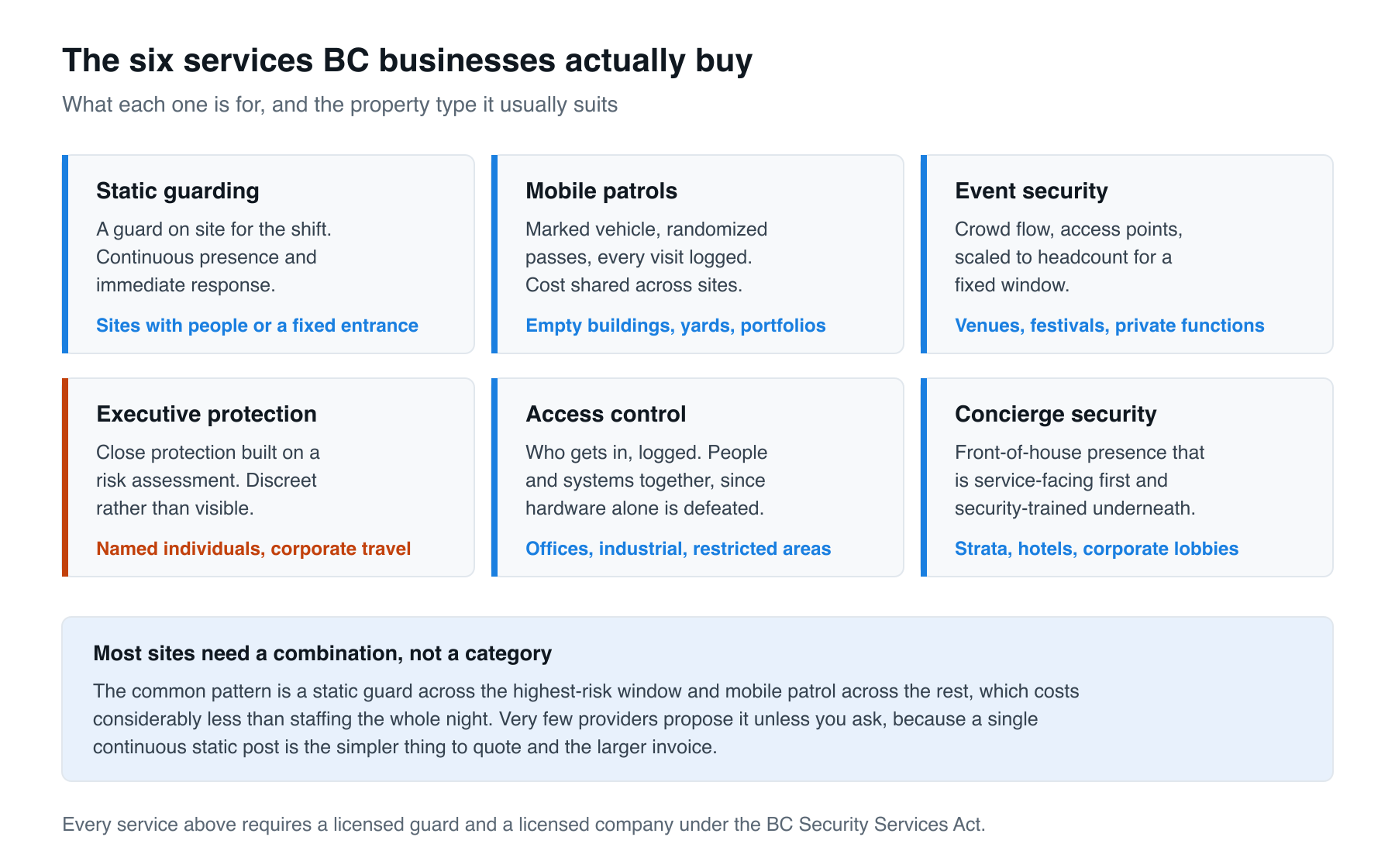
Static guarding
A licensed guard on your site for the duration of the shift.
You are buying continuous presence. The guard controls a point, responds immediately to anything that happens, and is visible enough to deter attempts before they start.
It suits sites with people on them, a fixed entrance requiring control, or a risk that runs throughout the shift rather than clustering in a window.
It is the most expensive per site, because nothing is shared. One guard, one property, for every hour booked.
Our static guards explained piece goes deeper, and the service page covers how we deliver it.
Mobile patrols
A marked vehicle attending your property several times a night at randomized intervals, with every visit logged.
Because the cost of the vehicle and officer spreads across several client sites, mobile patrol delivers a large share of the deterrent value of a guard for a fraction of the cost.
It suits empty buildings, yards, compounds, construction sites and multi-property portfolios.
The trade-off is the gap. Between passes, nobody is there. For a vacant warehouse that is usually acceptable. For a site with people on it, it is not.
See mobile patrol security explained and our mobile patrols service.
Event security
Coverage scaled to a headcount for a fixed window, rather than an ongoing arrangement.
Event work is its own discipline. Crowd flow, access point control, ticket and ID verification, and the ability to de-escalate in an environment where people have been drinking and standing for hours. A guard who is excellent on a quiet industrial gate is not automatically good at this.
It suits venues, festivals, private functions and anything with a crowd and a defined start and end.
It prices at the higher end, because it is short-notice, short-duration and staffing-intensive.
Our event security checklist covers how to scope it, and event security costs in Vancouver covers the numbers.
Executive protection
Close protection for a named individual, built on a risk assessment.
This is the most misunderstood service on the list. Done properly it is discreet, mostly administrative, and heavily weighted toward advance work rather than visible presence.
It suits visiting executives, corporate travel, high-profile individuals and situations with a specific identified threat.
It costs more than any other service and should always start with an assessment rather than a headcount.
Our executive protection guide sets out what it actually consists of.
Access control
Managing and documenting who enters, using people and systems together.
The reason this is a staffed service rather than a hardware purchase is that access control hardware fails at the human layer. Doors get propped. People tailgate. Contractors talk their way in. A card reader cannot notice any of that.
It suits offices, industrial sites, data facilities and anywhere with areas that must stay restricted.
It often pairs with concierge coverage, since both sit at the entrance.
See access control and concierge security and the service page.
Concierge security
Front-of-house coverage that is service-facing first and security-trained underneath.
The person greets residents, signs for parcels, directs visitors and manages the desk. They are also licensed, trained in de-escalation, and able to handle an incident rather than phone someone about it.
It suits strata buildings, hotels, corporate lobbies and residential towers, anywhere the front desk is both a service point and the building's main vulnerability.
Our concierge versus front-desk staff comparison covers the distinction, and the service page covers delivery.
Choosing between them
Work from the problem, not the catalogue.
1. When does your risk actually occur? If incidents cluster between midnight and 4am, you need coverage then, not a 12-hour shift.
2. Is anyone on site? People on site push you toward static or concierge. An empty building points to patrol.
3. Is there a point to control, or an area to cover? A point suggests static or access control. An area suggests patrol.
4. Is deterrence enough, or do you need response? Deterrence can be intermittent. Response cannot.
5. What does your budget actually allow? Honestly. A provider who knows your ceiling can propose a hybrid rather than quoting a full static post you will decline.
The commonest good answer is a combination: static across the highest-risk window, patrol either side. Most providers do not propose it unless asked, because a single continuous post is simpler to quote and larger to invoice.
What every service should include
Regardless of which you buy, these are not extras:
- Licensed guards, verified, plus a licensed company. Both are required under the Security Services Act.
- Named supervision with a documented site visit schedule.
- GPS-verified attendance records and incident reports with photographs, delivered promptly.
- Liability insurance you have seen the certificate for. Fireball Security carries $2M CAD in comprehensive general liability.
- Written post orders, so the guard knows your site rather than improvising.
If a quote does not include all five, it is cheaper for a reason. Our guide to choosing a security company in BC covers the vetting.
Frequently asked questions
1. What is included in security guard services?
A licensed guard, supervision, relief coverage, insurance, scheduling and reporting. The hourly rate covers all of it, which is why comparing it to a bare wage is misleading.
2. What is the difference between static guarding and mobile patrol?
Static means a guard remains on your site for the shift. Mobile means a vehicle attends several times at randomized intervals. Static gives continuous presence; mobile gives deterrence and documented attendance at lower cost.
3. How much do security guard services cost in BC?
Generally from around $28 per hour into the $40s depending on service type, hours and notice. See our cost guide.
4. Can I combine services?
Yes, and for many sites it is the best answer. Static across the highest-risk window with patrols either side typically costs far less than staffing the whole period.
5. Do all security services require licensed guards?
Yes. Every service listed here requires individually licensed guards working for a licensed security business under the Security Services Act.
6. Which service is best for an empty commercial building?
Usually mobile patrol. There is nobody on site to protect, so you are buying deterrence and provable attendance, which patrol delivers at a fraction of static cost.
7. What is concierge security, and how is it different from a receptionist?
A concierge security officer performs front-desk duties but is licensed and trained to handle incidents directly rather than escalating them. Our comparison sets out where the line falls.
Getting the right service quoted
Send providers the problem rather than the service name, and let them propose. If they all come back with the same recommendation, it is probably right. If one proposes something materially cheaper that solves the same problem, that is worth hearing.
Fireball Security has operated across British Columbia since 2020, serving 100+ clients in 11 cities with 100+ licensed guards. Tell us what you are dealing with and we will come back within 60 minutes during business hours, or call 250-899-6620.